Start with the claim, then find the material
Most buyers start by asking for "eco-friendly fabric". A better starting point is the sentence you want to print. "Made with organic cotton", "contains recycled nylon" and "tested for harmful substances" each need different evidence. Once the claim is clear, the fabric choice, the scheme and the paperwork follow. We coordinate with partner mills and factories to collect that evidence, and we check certificates by number lookup. SutraKnit does not hold these certificates itself.
Organic cotton yoga wear
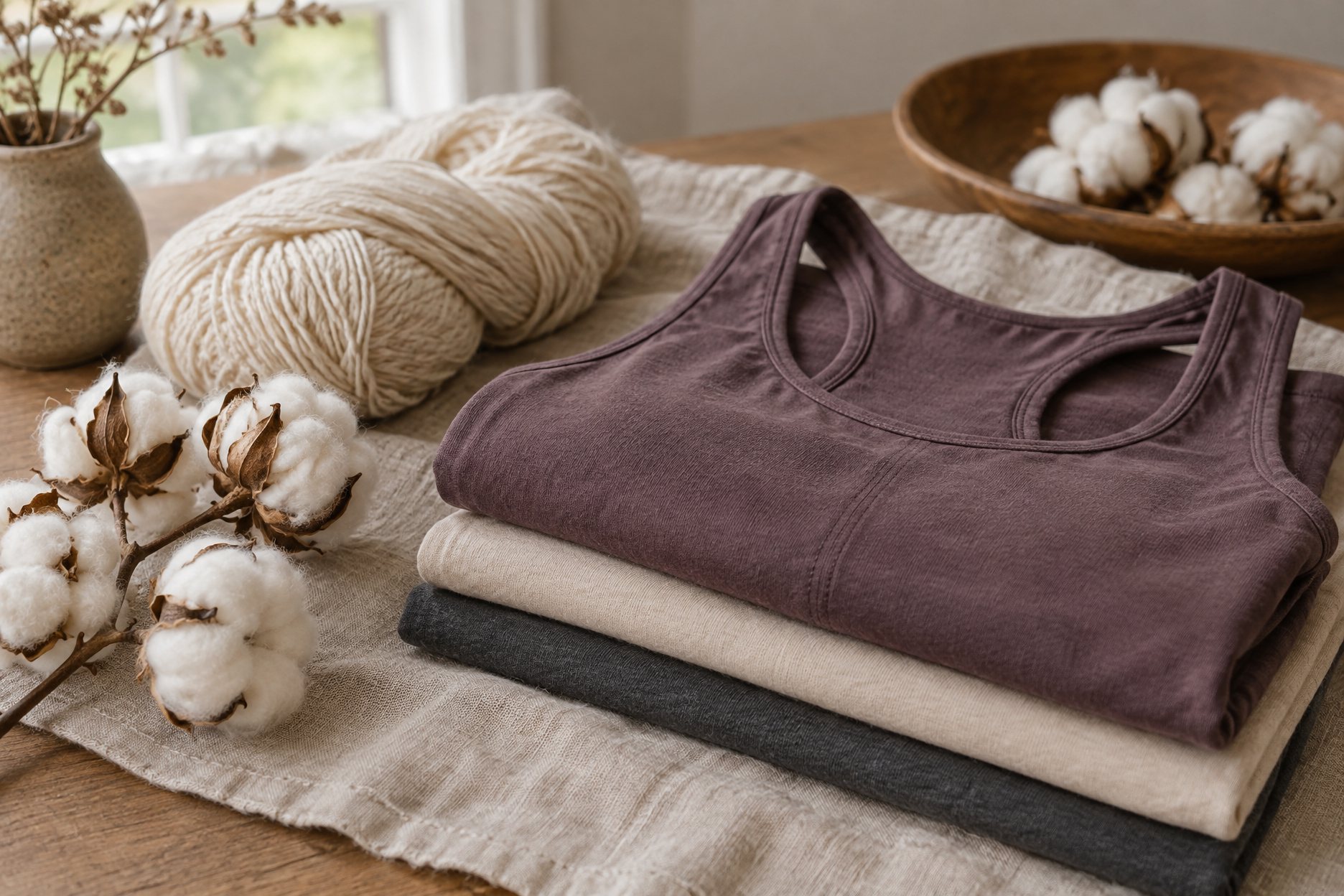
Organic cotton/spandex jersey suits loose, meditation and restorative yoga styles where a cotton hand matters more than compression. Composition and weight are confirmed per fabric sheet. If you want to call a garment organic, the relevant scheme is GOTS. Under GOTS, the "organic" label grade requires at least 95% organic fiber, and "made with organic" requires at least 70%. A cotton/spandex blend therefore needs care in how it is described. See loose yoga clothes for the garments where cotton works best, and our guide to sourcing organic cotton yoga wear.
Recycled nylon and polyester
Recycled nylon and polyester yarns can replace virgin yarns in many performance fabrics. The look and stretch are often close to the virgin version, but hand feel, color range and availability vary by mill, so always compare on a sample. The relevant scheme is GRS. GRS covers products with at least 20% recycled material, and use of the GRS label requires at least 50%. Ask the mill for the recycled share on the fabric sheet and for the scheme documentation that covers it.
| Scheme | What it covers | Typical use in yoga wear |
|---|---|---|
| GOTS | Organic textiles; label grades at 95% and 70% organic fiber | Organic cotton jersey for loose and meditation wear |
| GRS | Recycled content; scheme from 20% recycled, label from 50% | Recycled nylon or polyester performance fabrics |
| bluesign | Chemical management system for mills | Mill-level chemical control on synthetic fabrics |
| OEKO-TEX STANDARD 100 | Harmful substances; class II for skin contact | Fabric or trims tested for substances of concern |
| amfori BSCI, SMETA, WRAP | Social audits of factories | Factory working conditions, not fabric content |
Each of these is available on request where the mill or factory holds it, verified by certificate number lookup. A certificate belongs to a specific company and scope; it does not automatically cover your garment.
Chemicals: OEKO-TEX and bluesign
OEKO-TEX STANDARD 100 tests textiles for harmful substances and uses product classes; class II covers articles with skin contact, which includes most yoga apparel. bluesign is a chemical management system applied at mill level. Neither is a sustainability claim on its own. They are evidence about chemistry, so describe them precisely rather than folding them into a general "eco" message. Read OEKO-TEX STANDARD 100 for activewear.
PFAS
Water and stain repellent finishes have historically used PFAS chemistry. California AB 1817 restricts intentionally added PFAS in textile articles from 2025, and other states have similar laws, so check current state requirements for every market you sell into. Most yoga apparel does not need a repellent finish at all. Ask the factory to confirm in writing that no PFAS-based finish is applied, and keep that record with the program file.
Bamboo, modal and viscose
"Bamboo" fabric is usually viscose made from bamboo pulp. Under FTC guidance it must be labeled as rayon or viscose made from bamboo, not simply "bamboo". Modal is also a regenerated cellulose fiber. Both feel soft and drape well, which suits loose styles, but they are not automatically sustainable and should not be described that way without qualification.
The FTC Green Guides in plain terms
The Green Guides ask marketers to avoid unqualified environmental claims. "Eco-friendly" or "sustainable" on its own implies a broad benefit that is almost impossible to prove. A qualified, specific claim is easier to defend: "made with recycled nylon", with the share stated, or "organic cotton certified to GOTS", where the certificate covers the product. Our article on eco claims and the Green Guides includes example wording.
How to document a claim
- Write the claim - the exact sentence planned for labels, hang tags and product pages.
- Match it to a scheme or test - GOTS, GRS, OEKO-TEX or a written chemical statement.
- Collect certificates - from the mill or factory that holds them, with certificate numbers checked by lookup.
- Link to the bulk fabric - confirm the certified fabric is the one used in production, with lot references.
- Keep the file - store certificates, fabric sheets and the written confirmation with the order.
Trims and packaging count too
A garment is more than its main fabric. Elastic, thread, labels, cups and polybags all sit in the finished product. If your claim covers the whole garment, ask whether trims are covered by the same scheme or tested separately, for example under OEKO-TEX STANDARD 100. If the claim covers only the main fabric, say so on the label, such as "body fabric made with recycled nylon". Precise wording protects you more than a broad one.
MOQ and calendar
Garment MOQs follow the route: typically 100-300 pcs per style per color for cut and sew and 300-500 pcs for seamless. Certified or recycled fabrics often carry their own fabric minimums, which can be higher than the garment MOQ. Sampling typically takes 7-15 days and bulk typically 30-45 days after sample approval and fabric availability. Every figure is confirmed in writing for each program. See compliance for the wider rule set, or send a brief with the claims you want to make.