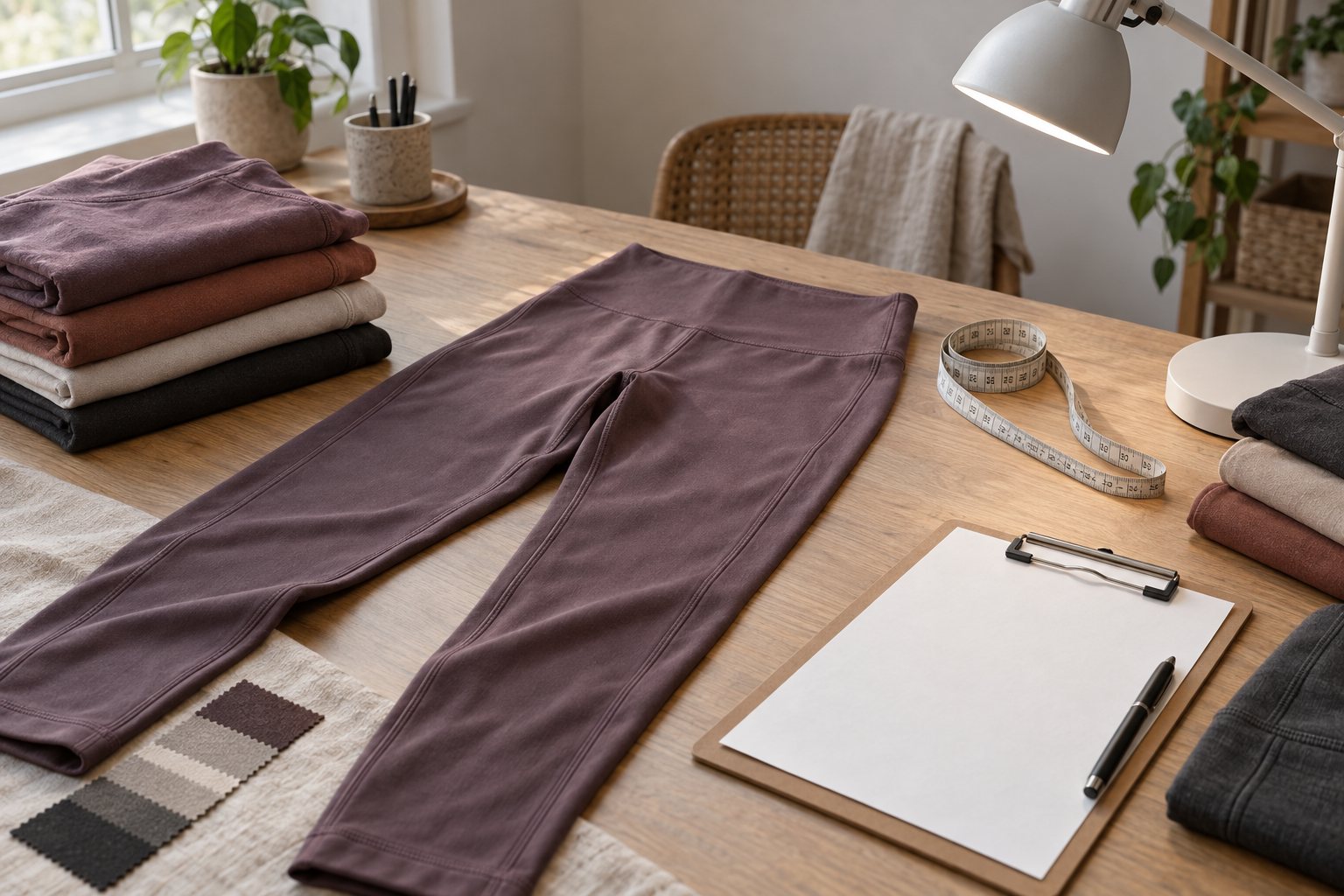
What quality means for yoga wear
A yoga garment fails in a few predictable ways: it turns sheer in a forward fold, the waistband rolls, seams pop at the gusset, colors bleed after the first wash, or the fabric pills at the inner thigh. A useful quality plan checks for those specific failures rather than a generic list. It also checks against documents the buyer has approved: the fabric sheet, the tech pack and the sealed sample.
Checkpoint 1: incoming fabric inspection
For cut and sew programs, fabric is checked when it arrives at the partner factory and before cutting starts. Problems found here are cheap to fix. Problems found after cutting are not.
- Weight - GSM measured against the fabric sheet. A tolerance of about plus or minus 5% of nominal is typical, measured to ISO 3801 or ASTM D3776.
- Width and shade - usable width checked, and each roll compared with the approved color standard so shade lots can be kept together.
- Visible defects - holes, runs, stains and barre marks on a sample of rolls.
- Hand and stretch - compared with the approved swatch, especially after brushing.
For seamless programs, the equivalent check is on dyed yarn and on the first pieces off each machine.
Checkpoint 2: in-line checks
In-line checks happen while garments are being sewn or knitted. The point is to catch a repeating fault, such as a skipped stitch on one flatlock machine or a knitting program producing short inseams, before it is repeated across the whole order.
Typical in-line points are seam strength at the gusset and crotch, waistband attachment, logo placement, measurement of early pieces against the tech pack and shade consistency between panels of the same garment.
Checkpoint 3: final random inspection to an agreed AQL
When production is finished and at least most goods are packed, a final random inspection is carried out. The inspector draws a random sample from the cartons, checks it and counts defects.
How AQL works, in plain terms
AQL stands for acceptance quality limit. It is a statistical sampling method: instead of checking every piece, the inspector checks a sample whose size depends on the order quantity and the inspection level. Each defect found is classified, usually as critical, major or minor. The AQL level sets how many defects of each class are allowed in that sample before the lot fails.
A stricter AQL level allows fewer defects. The right level depends on the product, the retail price and the buyer's own standards. We do not apply a fixed level to every order. The AQL level, the defect classification and what happens if a lot fails are agreed per order and confirmed in writing. Our note on AQL inspection for activewear explains the tables in more detail.
| Defect class | Typical yoga wear examples |
|---|---|
| Critical | Issues the buyer defines as safety or legal, such as a missing required fiber or care label, or a sharp object found in a garment |
| Major | Open seam, sheer area, measurement out of tolerance, wrong color, logo misplaced, stain that would stop sale |
| Minor | Loose thread end, slight crease, small uneven stitch that does not affect use |
The classification above is a common starting point. The final list is written into the order terms so that the inspector and the buyer work from the same definitions.
Opacity and the squat review
Opacity is the property buyers worry about most. The squat test, where a wearer or fit form takes a deep squat under bright light, is a practical sample review method, not an official standard. We use it at sampling on the lightest color in the range, because a fabric that is opaque in black can show skin in sand or white. If opacity is a listed requirement, bulk pieces are reviewed the same way during final inspection. See the squat-proof test for yoga leggings.
Measurement tolerances
Every point of measure on the tech pack should have a tolerance: waist relaxed, hip, front and back rise, inseam, leg opening, waistband height and so on. Inspectors measure sampled pieces against those tolerances. Without tolerances on the tech pack, there is nothing to fail a garment against, and arguments start after delivery. Knitted garments stretch, so the tech pack should also state how pieces are measured: relaxed, flat and after any setting.
Laboratory tests alongside inspection
Inspection checks workmanship. Laboratory tests check fabric properties such as colorfastness, pilling, dimensional change and stretch recovery. Which tests to request depends on the product and the market, and is covered on the testing and compliance page. When tests are part of the order, the test reports sit beside the inspection report in the order file.
What the buyer receives
- A fabric check note for cut and sew programs, covering weight, shade and visible defects.
- In-line findings where faults were found and corrected.
- A final inspection report: order quantity, sample size, AQL level used, defects by class, measurement records, photos of packing, labels and any defects, and the result.
- Any laboratory test reports that were part of the order terms.
When a lot fails
If a final inspection fails, the usual steps are sorting and rework at the partner factory, followed by re-inspection. What happens next, and who covers the cost of re-inspection, is set out in the written order terms rather than decided under pressure. For issues found after delivery, see buyer support.
To agree an inspection plan for your styles, include your preferred AQL level and any must-pass items in your brief.