Why hot yoga needs its own specification
Hot and bikram-style classes run in heated rooms where students sweat heavily for the whole session. Fabric that performs well in a cool studio can behave differently once it is saturated. It gets heavier, it can cling, and some constructions become more see-through when wet than when dry. A buyer who simply reuses a standard legging spec for a hot yoga line often discovers these problems only after the first customer reviews.
The answer is not a special fiber. It is a set of decisions about surface, weight, cut and testing that are written into the tech pack. We coordinate these choices with the partner factory and the mill, and we check them on samples worn in realistic conditions before bulk is confirmed.
Wet opacity comes first
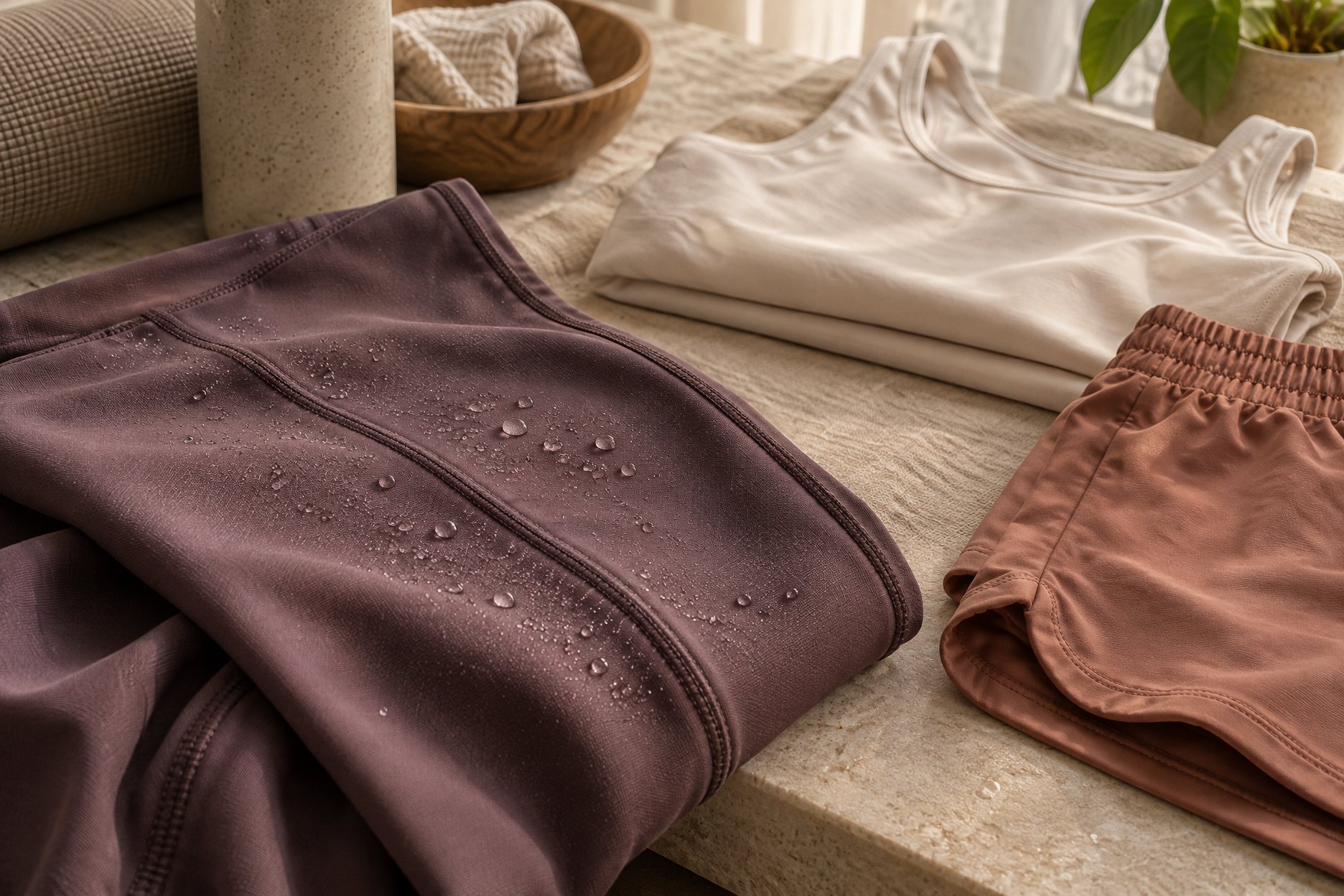
Dry opacity is what most buyers test with the squat test. Hot yoga customers judge opacity wet. A dark legging in a nylon/spandex interlock at 230-240 GSM may pass when dry, while white and pastel shades often need 280-300 GSM even in normal conditions. In a heated class those margins shrink. When you review samples, wet a section of the seat and knee and repeat the stretch check under bright light. The squat test is a practical sample review method, not an official standard, so record the result with photos against the approved sample.
If your hot yoga range includes light colors, either accept a heavier base for those shades, plan a lined front panel on shorts, or keep light colors to tops and bras where opacity is less critical. Our note on the squat-proof test explains how to document the check.
Smooth or brushed for a heated room
Brushed ("peached" or "buttery") nylon/spandex is popular for its soft hand, but brushing raises the surface fibers and can hold more water against the skin. Many hot yoga lines prefer a smooth face that releases sweat and dries faster. That is a tendency, not a rule: the yarn, knit and finish all matter. Ask for both options on the same color, wear them in a heated class, and compare how they feel at the end of the session rather than at the start.
| Decision | Common choice for hot yoga | What to check on the sample |
|---|---|---|
| Surface | Smooth face nylon/spandex or polyester/spandex | Cling and drying feel at the end of a heated class |
| Legging weight | Nylon/spandex interlock in the 230-280 GSM range | Wet opacity on seat and knee, especially light colors |
| Tops and shorts | A lighter weight than leggings, set on the fabric sheet | Transparency when wet, shape after washing |
| Spandex share | Around 15% for comfort, 20-25% for firmer hold | Grip in sweat, recovery after stretching |
| Moisture claim | Verified with AATCC 195 if you print a claim | Test report matched to the production fabric |
| Colorfastness | AATCC 15 / ISO 105-E04, grade 3-4 commonly accepted | Staining on the multifiber strip and on light trims |
Lighter weights for tops and shorts
Students in hot classes tend to wear less. Bra tops, cropped tanks and shorts carry a large share of hot yoga sales. These pieces can use a lighter fabric than leggings because they cover less area under tension. The exact weight is a fabric sheet decision for each style, confirmed against a wet-wear sample. For shorts, think about leg opening grip and whether a liner is wanted; see yoga shorts for construction options and yoga tops for necklines and backs.
Moisture management and quick dry claims
"Moisture-wicking" and "quick dry" are among the most used words on activewear labels. If you print them, be able to support them. AATCC 195 measures liquid moisture management properties of a fabric and gives a structured report rather than a vague impression. A test report belongs to a specific fabric quality, so it has to match the fabric actually used in bulk. Our article on moisture-wicking claims covers how to word them.
Grip in sweat
Hot yoga customers want garments that stay put when wet. Waistbands are the usual problem: a high-rise band that grips dry can roll or slip once soaked. A taller, multi-layer waistband (height confirmed on the tech pack) and a firmer spandex share help. Leg openings on shorts and bottom bands on bras need the same attention. Silicone grip tape is an option on some styles, but test it against the fabric and the wash program before adding it to every piece.
Colorfastness to perspiration
Sweat is mildly acidic or alkaline, and it can move dye. Dark and saturated colors placed next to white piping or a light panel are the classic risk. AATCC 15 or ISO 105-E04 tests colorfastness to perspiration, and grade 3-4 is a common acceptance level. Add AATCC 61 for laundering, because hot yoga garments are washed after almost every wear. Read more in colorfastness testing.
Men's and women's hot yoga lines
Women's hot yoga lines usually center on bra tops, shorts and leggings in smooth fabrics. Men's lines lean on shorts with or without liners and lightweight tanks; inseam length and liner comfort decide sell-through more than color. A men's line has a smaller size curve and fewer styles, so plan it as a focused capsule. See men's yoga wear for the construction details.
MOQ, sampling and lead time
Hot yoga styles follow the same routes as other activewear. On cut and sew, the typical reference MOQ is 100-300 pcs per style per color; on seamless it is 300-500 pcs. First samples typically take 7-15 days, and bulk typically takes 30-45 days after sample approval and fabric availability. Every figure is confirmed in writing for each program. Allow extra time for a wet-wear review round, because it is the step that catches most hot yoga problems.
What to send
- The styles you plan for the hot yoga line and reference photos.
- Your color plan, flagging any white or pastel shades.
- The claims you want on labels, such as moisture-wicking or quick dry.
- Quantity ranges per style and your target delivery date.
With that, the desk can propose fabrics, a testing plan and a sampling calendar. Send a brief when you are ready.