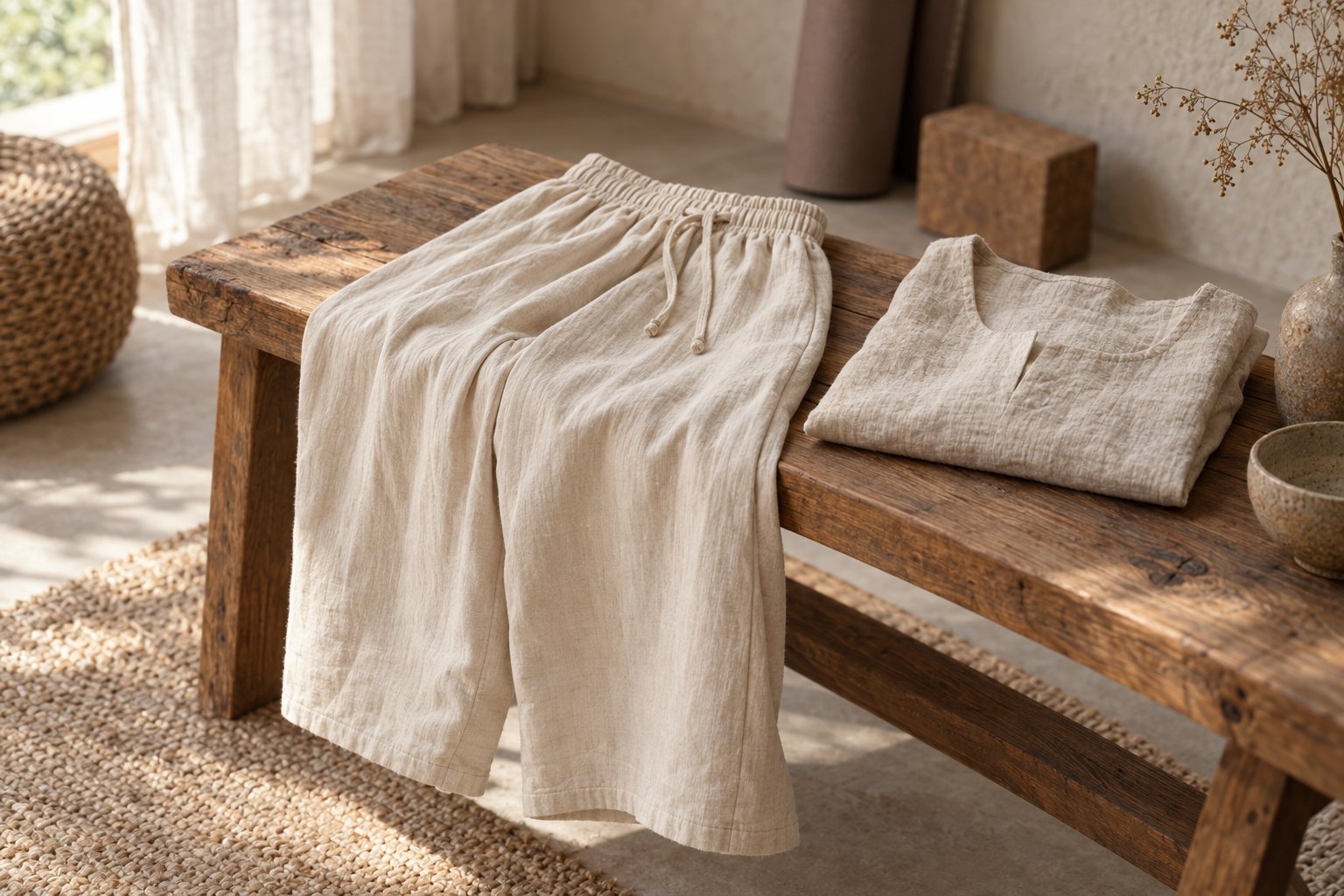
Who buys loose yoga clothes
Loose yoga clothes serve practices where the body stays still or moves slowly: restorative, yin, meditation, breathwork and kundalini classes, retreats and teacher trainings. The customer wants freedom around the waist and legs, a fabric that breathes and feels natural, and often a calm, plain look. Many also wear these pieces as lounge and travel clothes.
These garments sit outside the performance knit world. They are usually cut and sew, often in woven fabrics, and the production risks are different: shrinkage, opacity in light colors, wrinkling and accurate fiber labeling.
Practice context shapes the garment
A restorative or yin class involves long, supported holds on bolsters and blankets, so the customer wants soft waistbands with no hard elastic and no bulky seams at the back of the body. Kundalini practitioners often wear white, loose, layered clothing, which puts opacity and color transfer at the center of the brief. Meditation and breathwork call for clothes that stay comfortable cross-legged for long periods, which means room through the seat and knee and a waist that does not press on the abdomen. Retreat and teacher training wear has to look good after travel and many washes. Write the practice context into the brief, because it decides the waist, the fit and the fabric.
Construction details for loose pants
The waist is the main design choice. A wide fold-over knit waistband is soft and suits jersey fabrics. An elastic waist with a drawcord suits wovens such as linen and cotton. A wrap or tie waist fits a wide size range but needs clear instructions. Side seam pockets are popular on wide-leg pants; ask for pocket bags in a lighter fabric so they do not show through light colors. Hem finishes, such as a deep turned hem or a cuff on harem pants, change both the drape and the fabric consumption.
Style and fabric ledger
| Style | Common fabrics | Key decisions |
|---|---|---|
| Wide-leg pants | Linen, cotton, modal jersey, viscose | Waist (elastic, drawcord, fold-over), leg width, length, pockets |
| Harem pants | Cotton, viscose, modal jersey | Drop crotch depth, cuff, waist |
| Meditation sets | Organic cotton/spandex, modal, linen | Matching color across top and pant, relaxed fit, layering |
| Loose tops and tunics | Cotton jersey, modal, viscose (bamboo), linen | Length, neckline, sleeve, opacity |
| Wraps and layers | Cotton or modal knits, linen blends | Drape, closure, care |
Natural fibers and their trade-offs
Cotton and organic cotton
Cotton yoga wear feels familiar and breathes well, but plain cotton holds sweat and dries slowly. A cotton/spandex jersey keeps shape better than all-cotton jersey. If you plan an organic claim, the fabric needs a credible certification chain: under GOTS, the "organic" label grade requires at least 95% organic fiber and "made with organic" at least 70%. Certificates are available on request where the mill holds them, verified by certificate number lookup. See sourcing organic cotton yoga wear.
Linen
Linen yoga clothes are cool, breathable and become softer with washing. They also wrinkle, have little stretch and can feel rough in the first wears. Linen suits wide-leg pants, loose tops and retreat wear, not fitted practice garments. A linen blend can reduce wrinkling and roughness. Our note on where linen works and where it does not goes deeper.
Modal and viscose
Modal and viscose jerseys drape beautifully and feel cool. They can shrink and lose shape if washed hot, and they pill more readily than nylon. Fiber made from bamboo is usually viscose and should be labeled as viscose or rayon made from bamboo under FTC guidance. Compositions and weights for these fabrics are confirmed per fabric sheet.
Shrinkage control
Shrinkage is the main production risk for natural fiber garments. A pant that shrinks after the first wash loses length and the customer notices at once. The controls are:
- Test dimensional change after laundering (AATCC 135) on the bulk fabric before cutting.
- Ask whether the fabric is pre-shrunk or compacted, and get it in writing.
- Adjust the pattern for any remaining shrinkage, so the finished garment meets spec after washing.
- Consider garment washing for linen and cotton pieces where a softer, lived-in look is wanted.
- Write care instructions that match the test results under the Care Labeling Rule.
See shrinkage and dimensional stability for test details.
White garments and opacity
White is common in meditation and kundalini wear, and it is where loose clothes most often fail. Thin white cotton jersey, light viscose and open-weave linen can be see-through, especially when damp or under bright light. The practical checks are:
- Hold the fabric against a dark surface and a light source, single layer, before approving it.
- Choose a heavier fabric or a denser weave for pants and tops worn without layers.
- Consider a partial lining at the seat or front panel for white pants.
- Review the sample on a body under studio lighting, dry and damp.
Whites also show color transfer from labels, trims and dark pieces in a set. Colorfastness to crocking (AATCC 8) and to laundering (AATCC 61) on colored components helps. Our note on white yoga clothes: opacity and care covers more.
Claims and labels
Loose natural fiber lines are often marketed with environmental language. Under the FTC Green Guides, unqualified "eco-friendly" or "sustainable" claims should be avoided. Fiber content must be stated by percentage, with country of origin and dealer identity, under the Textile Fiber Products Identification Act. The sustainable yoga wear page explains how to make claims that hold up.
Flammability rules for clothing textiles (16 CFR 1610) also apply. Some fabrics are exempt from testing, such as plain-surface fabrics of 2.6 oz/yd² or more and fabrics made entirely of certain synthetic fibers or wool. Light cotton, viscose and linen fabrics are not covered by the fiber exemption, so check with your lab whether testing is needed for each fabric.
MOQ and timeline
Loose natural fiber garments go to cut and sew partners, typically at 100-300 pcs per style per color, confirmed in writing for each program. Woven fabrics such as linen may carry a fabric minimum that sets the order floor. First samples typically take 7-15 days, and bulk typically 30-45 days after sample approval and fabric availability, plus any garment washing step. Send your brief with the fabrics and colors you have in mind.