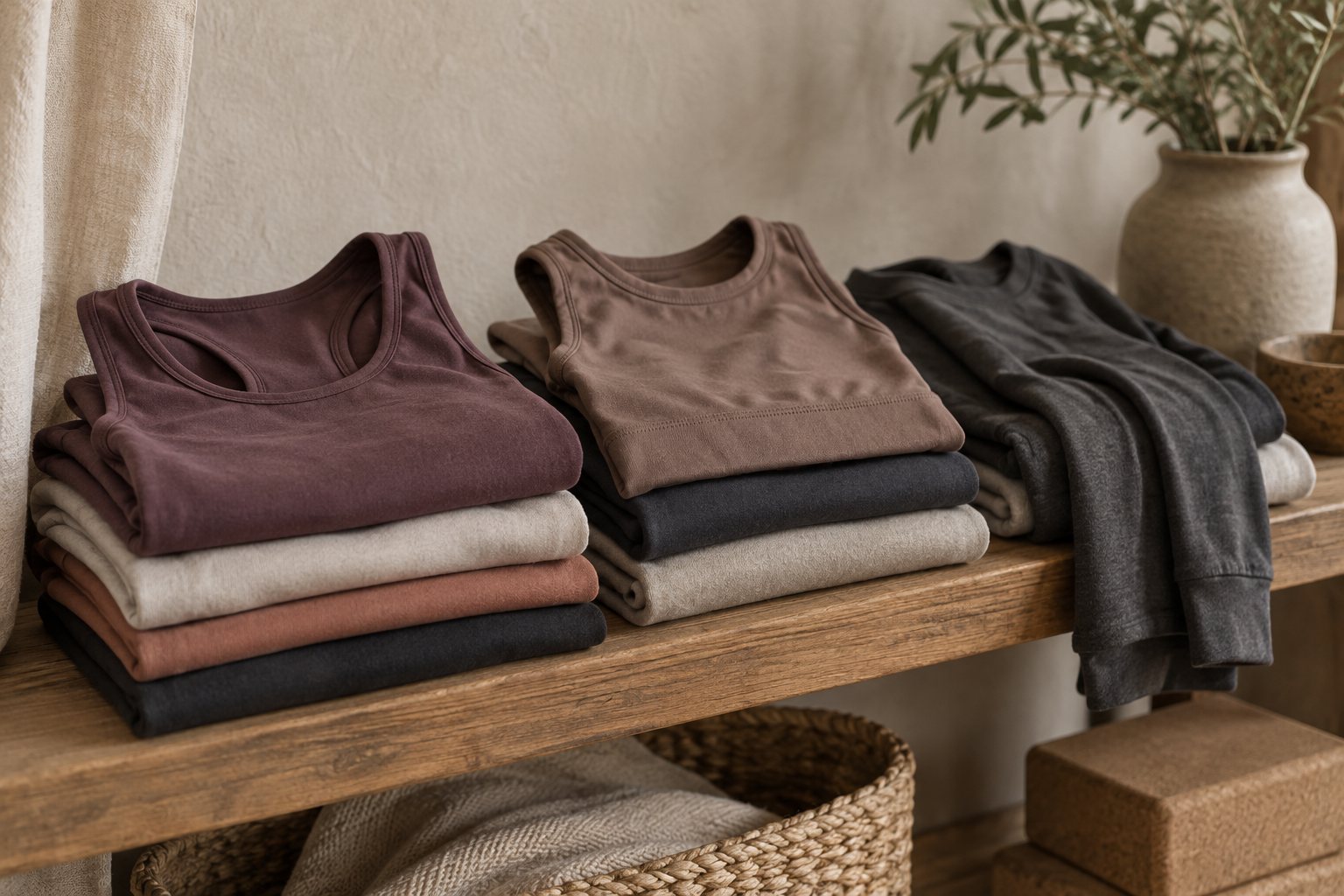
Two jobs for yoga tops
Women searching for yoga clothes for women shirts or yoga tops want two different things. Some want a fitted top that stays in place on the mat, with no hem flipping over the face in downward dog. Others want a soft, looser layer for the start and end of class and for wearing outside the studio. A strong range covers both jobs, and the two use different fabrics and different patterns.
The desk plans tops as part of the wider collection, so colors and fabrics line up with the leggings and bras they will be sold with.
Style ledger
| Style | Typical fabric | Key decisions | Usual route |
|---|---|---|---|
| Fitted tank | Nylon/spandex interlock or rib | Length, armhole depth, back style, hem grip | Cut and sew or seamless |
| Shelf-bra tank | Nylon/spandex with inner band | Shelf band width, pad pocket, support level | Cut and sew |
| Crop top | Nylon/spandex, ribbed seamless knit | Crop length vs legging rise, neckline | Cut and sew or seamless |
| Long sleeve | Nylon/spandex, brushed knit, seamless rib | Thumbholes, sleeve length, fitted or relaxed | Cut and sew or seamless |
| Layering tee or tank | Modal, viscose (bamboo), cotton/spandex | Drape, shrinkage, opacity of light colors | Cut and sew |
Fitted tanks and crops
A fitted tank for practice needs a hem that stays down when the wearer inverts. Options are a longer body length, a slightly narrower hem, a hem band with more grip, or a knitted hem zone on seamless tanks. The armhole should be deep enough for movement without exposing the bra underneath, unless the design is meant to show the bra.
Crop tops are paired with high-rise leggings, so the crop length should be set against the legging rise. A crop that ends just above the waistband shows a small strip of skin; one that overlaps reads as a tank. Agree the intended look and confirm the body length on the tech pack.
Built-in shelf bras
A shelf-bra tank combines a tank with an inner band and sometimes a pad pocket, so it can be worn without a separate bra for light support. The inner band is a separate elastic or knitted band sewn at the underbust. The common issues are a band that rolls, pads that shift and a lining that shows at the armhole. Fit the shelf bra on the sample like a light support bra, and specify pad shape and pocket opening. The sports bras page covers support levels and cup choices.
Long sleeves and cold-studio tops
Long sleeves serve cold studios, outdoor practice and warm-up layers. Fitted long sleeves in nylon/spandex or seamless rib work on the mat. Brushed knits in the winter-weight range of about 260-320 GSM give warmth for cold studios and outdoor wear, with the finished weight confirmed on the fabric sheet. Thumbholes keep sleeves in place in downward dog, but they need reinforcement so they do not tear at the cuff.
Layering pieces in modal and viscose
Soft layering tops often use modal, viscose or cotton/spandex rather than performance nylon. These fibers drape well and feel cool, but they behave differently in production and in the wash. Viscose and modal can shrink and lose shape more than synthetics, so dimensional change after laundering per AATCC 135 is worth testing on the bulk fabric. Light colors in thin viscose jersey can be sheer, so opacity needs checking as carefully as on leggings.
Labeling matters here. A fiber made from bamboo is usually viscose, and under FTC guidance it should be labeled as viscose or rayon made from bamboo, not simply "bamboo". See modal and bamboo viscose in yoga wear for feel, care and labeling notes.
Nylon tops vs natural feel tops
Nylon/spandex tops dry fast, keep their shape and match leggings in color because they can share the same fabric. Modal and viscose tops feel softer and more casual but take dye differently, so a lab dip is needed to match them to a legging color. Many lines use both: nylon for practice tops and modal or viscose for layering. Our fabric library lists the reference compositions.
Seamless tops
Seamless ribbed tanks, crops and long sleeves from the Yiwu cluster pair naturally with seamless leggings and bras. They are knitted on electronic circular seamless knitting machines with rib and texture programmed in. Each style needs its own knitting program, so seamless MOQs are typically 300-500 pcs per style per color, confirmed in writing. Cut and sew tops typically start at 100-300 pcs per style per color.
Sizing and grading tops
Tops are graded on chest, waist, body length and armhole. Fitted practice tops need tighter tolerances than relaxed layering pieces, because a small change in body length decides whether the hem stays down. If your range extends to plus sizes, adjust armhole depth and body length in the grade rather than scaling everything evenly; see the plus size yoga wear page for fit development.
Branding and finishing
Tops carry the most visible branding in a yoga line, usually a heat transfer or silicone logo at the chest, back neck or hem. On thin modal or viscose jersey, a heavy silicone logo can pull the fabric and show through; a small heat transfer or a woven label at the hem is often cleaner. Neck labels can irritate during practice, so many brands print the care and size information inside the neck instead, while still meeting US labeling rules for fiber content, origin, dealer identity and care.
Testing and timeline
Useful tests for tops include colorfastness to perspiration (AATCC 15 or ISO 105-E04, where grade 3-4 is a common acceptance), pilling (ASTM D4970 or ISO 12945-2) for soft knits, and dimensional change (AATCC 135). First samples typically take 7-15 days, and bulk typically 30-45 days after sample approval and fabric availability, confirmed in writing for each program. See MOQ and lead time or send a tops brief.