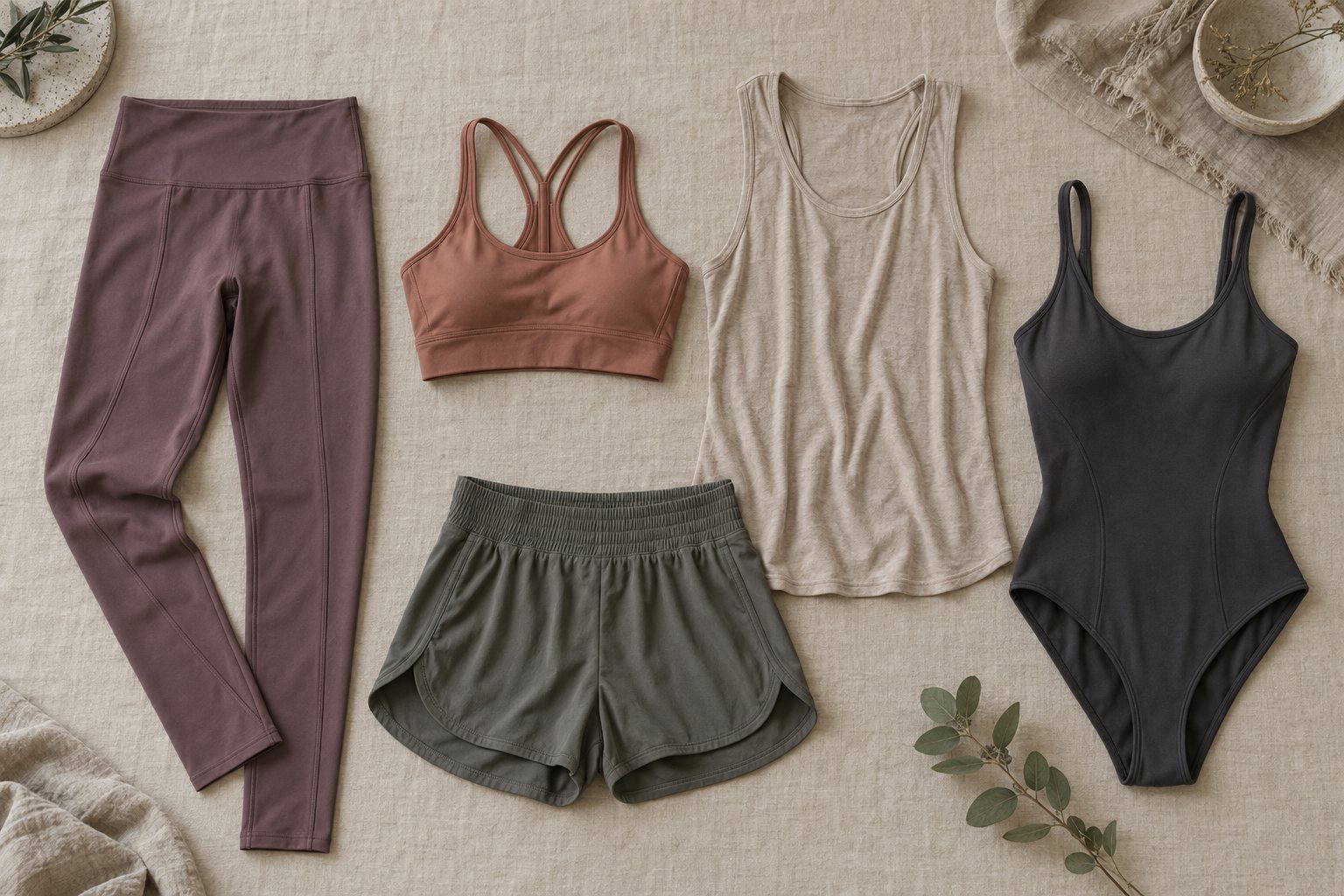
Start with the garment, then choose the route
Buyers looking for a yoga clothes manufacturer often start with a factory search. A faster approach is to start with the garment list. A legging with a gusset and side pockets, a ribbed seamless bra and a linen wide-leg pant are three different jobs, and they are rarely done well by the same production line. Once the garments are clear, the route and the partner factory follow.
SutraKnit is a sourcing desk, not a factory. We coordinate verified partner factories in two Chinese apparel clusters: the seamless circular knitting base around Yiwu, Zhejiang, and the cut and sew activewear base around Humen, Dongguan, Guangdong. Each garment category below lists the route it usually takes, the fabrics it usually uses and the spec decisions that change cost, MOQ and lead time.
Garment ledger
| Garment | Typical route | Common fabrics | Key spec decisions | Guide |
|---|---|---|---|---|
| Leggings | Cut and sew or seamless | Nylon/spandex interlock, brushed nylon/spandex, polyester/spandex | Rise, waistband, inseam, gusset, pockets, seam type, opacity | Leggings |
| Sports bras | Cut and sew or seamless | Nylon/spandex, ribbed seamless knit | Support level, removable or molded cups, straps, underband | Sports bras |
| Sets (2 and 3 piece) | Often seamless; cut and sew for printed or pocketed sets | Ribbed seamless knit, nylon/spandex | Color matching across pieces, MOQ per piece, set packaging | Yoga sets |
| One-piece suits | Seamless or cut and sew | Seamless knit, nylon/spandex interlock | Zip or no zip, torso length grading, straps | One-piece suits |
| Shorts | Mostly cut and sew | Nylon/spandex, polyester/spandex, woven shells | Inseam, leg opening, liner, gusset | Shorts |
| Tops | Cut and sew or seamless | Nylon/spandex, modal, viscose blends | Shelf bra, length, armhole, layering fit | Tops |
| Men's | Cut and sew | Polyester/spandex, nylon/spandex, cotton blends | Liners, rise, gusset, taper, pocket security | Men's |
| Loose and natural fiber | Cut and sew (woven and knit) | Organic cotton/spandex, modal, viscose (bamboo), linen | Shrinkage, opacity of light colors, labeling | Loose wear |
| Plus size | Cut and sew or seamless | Nylon/spandex at opacity weight | Fit model, grading, waistband width, inner thigh abrasion | Plus size |
| Kids | Cut and sew | Cotton/spandex, nylon/spandex | CPSIA testing, tracking labels, trims and cords | Kids |
The two routes in one paragraph each
Seamless circular knit (Yiwu cluster)
Seamless garments are knitted as a tube on electronic circular seamless knitting machines, with ribbing, compression zones and textures programmed into the knit. There are fewer seams to sew, which suits ribbed sets, seamless bras and one-piece suits. Each new style needs its own knitting program and machine setup, so seamless MOQs are typically 300-500 pcs per style per color, confirmed in writing for each program. Press reports describe several hundred yoga apparel businesses in Yiwu today, many of them converted from legging and hosiery knitting in recent years.
Cut and sew (Humen cluster)
Cut and sew garments start from a fabric roll that is cut to a pattern and sewn with flatlock or coverstitch machines. This route handles gussets, pockets, removable cups, color blocking, printed fabrics and woven pieces. Humen has a dense concentration of activewear exporters. Cut and sew MOQs are typically 100-300 pcs per style per color, confirmed in writing for each program. See seamless yoga wear for a deeper comparison.
Decisions that apply to every garment
Fabric family and weight
Most performance yoga apparel uses nylon/spandex interlock at about 75-80% nylon and 20-25% spandex, in the 230-280 GSM range. Dark colors may pass opacity at 230-240 GSM; white and pastel shades often need 280-300 GSM. Polyester/spandex is the usual print base. Loose and meditation wear moves to cotton, modal, viscose and linen. The fabric library lists the reference ranges and what to ask the mill for.
Sizing and grading
Size range is a commercial decision with production consequences. Extending from XS-XL to plus sizes needs a second fit model and adjusted grade rules, not just a scaled-up pattern. Bras may run in S-XL or in band and cup sizes. Write the size range into the brief before sampling, because it changes the pattern work and sometimes the factory choice.
Branding and trims
Heat transfer and silicone logos, reflective prints, woven labels, care labels, hang tags, polybags and size stickers are set per program. Custom elastics and molded cups have their own supplier minimums, which can set the floor for your order. US labels need fiber content, country of origin and dealer identity, plus care instructions.
Testing
Typical lab tests for yoga apparel include colorfastness to laundering (AATCC 61), to perspiration (AATCC 15 or ISO 105-E04) and to crocking (AATCC 8), pilling (ASTM D4970 or ISO 12945-2), dimensional change (AATCC 135) and stretch and growth (ASTM D2594). The squat or opacity check is a practical sample review, not an official standard. Which tests you need depends on the garment and the market; we help you decide before bulk.
How buyers usually combine categories
A studio retail corner often starts with leggings, bras and one top in two or three colors. An emerging brand often launches with a hero legging, a matching bra and a set. A wholesaler may want a broad men's and women's range at accessible price points. Each combination can mix routes: seamless sets from the Yiwu cluster and pocketed cut and sew leggings from the Humen cluster, for example.
When routes are mixed, each route keeps its own MOQ, sampling calendar and inspection. We confirm in writing which partner factory makes which style, so the order reflects both routes. Our collection planning note covers how to sequence a first range.
What to send with a garment brief
- Reference photos or sketches for each garment, with the features you want kept and changed.
- Target fabric family or the performance you need: opacity, compression, softness or natural fiber feel.
- Size range and fit notes, including any plus or kids sizes.
- Number of styles and colors, and a quantity range per style per color.
- Branding: logo method, labels, hang tags and packaging.
- The date the goods must reach your warehouse.
With that, the desk can propose a route per garment and a sampling plan. Typical first samples take 7-15 days and bulk typically takes 30-45 days after sample approval, both confirmed in writing for each program. Read MOQ and lead time for the full picture.