Why the route matters before the supplier
Most buyers start by searching for yoga apparel manufacturers and comparing quotes. The quotes rarely compare like with like, because a seamless legging and a cut and sew legging are made on different machines, from different inputs, with different minimums. Choosing the route first makes every later comparison honest.
SutraKnit is a sourcing desk, not a factory. We coordinate partner factories in two apparel clusters in China and assign each style to the route that suits its construction. The factory assigned to your program is named in writing before sampling, so you always know who is making your goods.
Route A: the Yiwu seamless knitting cluster
Yiwu, in Zhejiang province, has become a center for seamless yoga apparel. A China News Service Zhejiang report from March 2024 described the local yoga-apparel trade growing from a few dozen businesses ten years earlier to several hundred, with many workshops converting from leggings and hosiery in the past few years. We treat that as a press report and use it qualitatively: it explains why seamless capacity and know-how are concentrated there.
Seamless garments are knitted as a tube on electronic circular seamless knitting machines. Rib textures, compression zones, ventilation panels and waistbands are programmed into the knit rather than sewn on. The result has fewer seams and a body-mapped feel.
What the Yiwu route suits
- Seamless leggings and ribbed leggings with knitted-in waistbands.
- Ribbed matching sets and seamless bras.
- One-piece suits where a continuous knit avoids seams at the torso.
- Styles that rely on texture rather than print for interest.
Each new style needs its own knitting program and machine setup, and yarn is usually dyed before knitting. That is why the seamless route typically starts at 300-500 pcs per style per color, confirmed in writing for each program. More on the cluster in our note on the Yiwu seamless knitting cluster and the seamless yoga wear guide.
Route B: the Humen cut and sew cluster
Humen, a town in Dongguan, Guangdong, is home to a dense concentration of activewear exporters. Many private label makers list Humen addresses in supplier directories. We do not quote cluster-level statistics for Humen, because we have not verified any. What matters to a buyer is that fabric mills, trim suppliers, printers and sewing workshops sit close together, which keeps sampling practical.
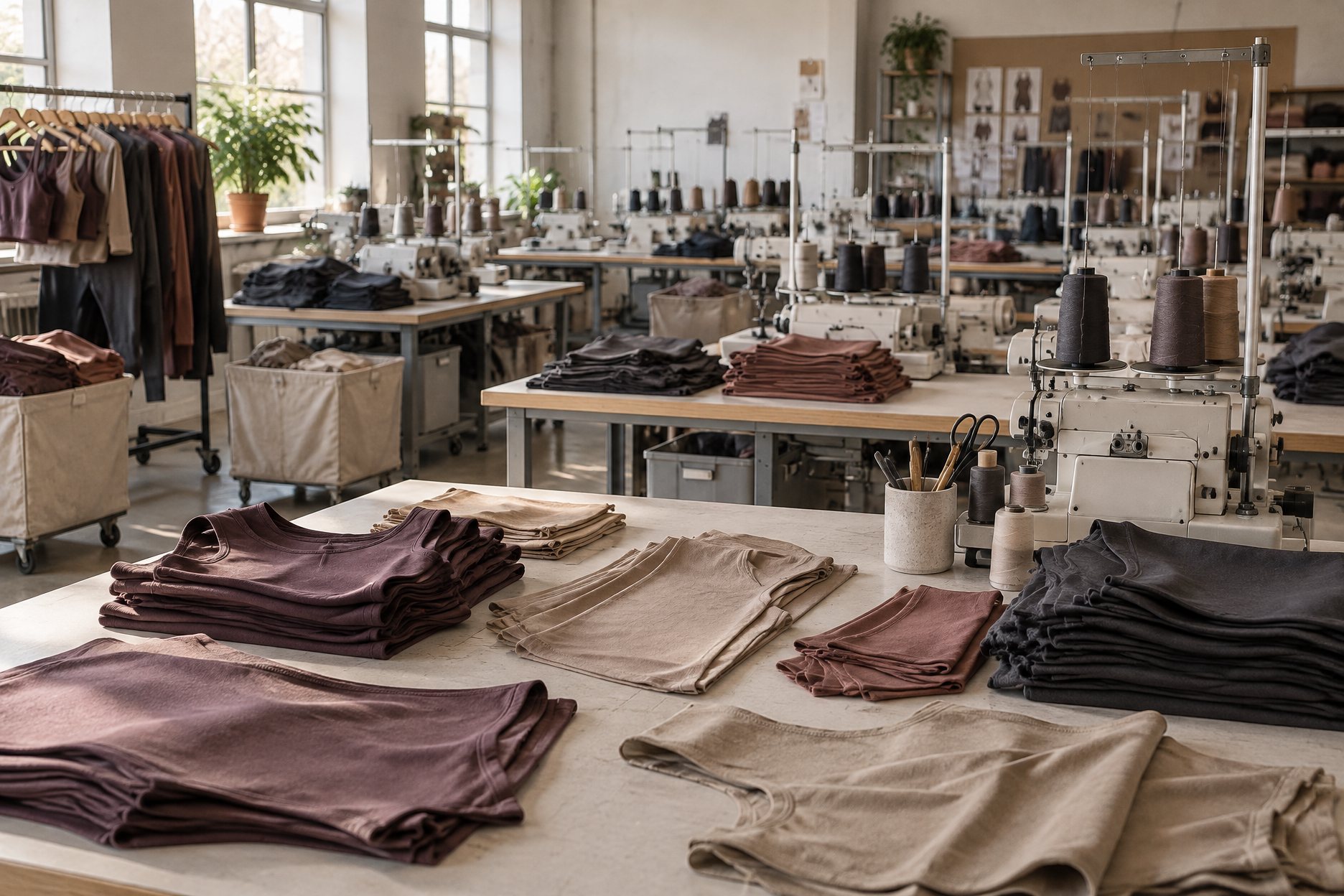
Cut and sew starts from a fabric roll. Panels are cut from a marker, then joined with flatlock or coverstitch seams, and finished with elastic, bonded edges or pockets as the tech pack requires.
What the Humen route suits
- Leggings with gussets, hidden waistband pockets and side drop-in pockets.
- Sports bras with removable pads, racerback or cross-back straps.
- Printed and color-blocked styles, including sublimation on polyester bases.
- Men's shorts with liners and woven pieces for studio layering.
Cut and sew programs typically start at 100-300 pcs per style per color, confirmed in writing. See Humen, Dongguan: the cut-and-sew activewear base for more context.
| Item | Seamless (Yiwu) | Cut and sew (Humen) |
|---|---|---|
| Starting input | Dyed yarn and a knitting program | Fabric roll and a paper or digital pattern |
| Typical MOQ | 300-500 pcs per style per color | 100-300 pcs per style per color |
| Strengths | Rib texture, body mapping, fewer seams | Pockets, gussets, prints, color blocking, pads |
| First sample | Typically 7-15 days once the program is written | Typically 7-15 days once fabric is agreed |
| Bulk | Typically 30-45 days after sample approval | Typically 30-45 days after sample approval |
All figures are typical reference ranges and are confirmed in writing for each program.
How we check a partner factory
A factory joins a program only after the desk has reviewed a set of documents and a sample. We do not rely on a directory listing or a showroom visit alone. The checks below are the minimum, and buyers can ask to see the evidence for the factory assigned to their program.
- Business license - the legal entity name matches the entity that will sign the written terms and issue the invoice.
- Audit reports, if held - where a factory holds a social audit such as amfori BSCI, SMETA or WRAP, we ask for the report and check its scope and date. We never state that a factory holds an audit it cannot show.
- Sample capability - the factory makes a sample in the relevant construction, so we see seams, edges and finishing rather than photos.
- Production evidence - photos or video of comparable styles in production and the equipment used for your route.
- Written terms - the factory accepts written confirmation of MOQ, colors, labels, inspection, packing and ship date before bulk.
Our factory vetting checklist explains each item in more detail and works for buyers sourcing on their own too.
What a factory profile shows
For each program we share a factory profile. Fields such as machine type, workshop size, headcount and typical monthly output are filled in from the factory's own documents. On this site those fields read "to be provided per factory profile", because they differ by factory and we do not publish figures we have not received in writing.
| Profile field | How it is filled |
|---|---|
| Legal entity and location | From the business license |
| Route and main equipment | To be provided per factory profile |
| Comparable styles made | Production photos or samples |
| Audits or certificates held | Only if a report or certificate is shown and checked |
| Typical capacity | To be provided per factory profile |
Mixed programs across both clusters
Many first collections need both routes: seamless ribbed sets from Yiwu and pocketed leggings from Humen. We coordinate both factories, keep separate sample rounds and inspections, and consolidate cartons before shipping if your delivery terms require it. Each route keeps its own MOQ and calendar, all confirmed in writing.
If you already know your styles, send a brief and we will propose a route for each one. If you are still comparing, start with MOQ and lead time by route.