How to use these comparisons
Each table compares two options on the points buyers actually decide on: hand feel, performance, appearance, cost position and the garments each suits. Ranges come from typical fabric sheets; the exact composition and weight for your program are confirmed on the fabric sheet. Treat these tables as a way to shortlist two or three fabrics, then compare them on samples. See the fabric library for the full set.
Nylon vs polyester
| Point | Nylon/spandex | Polyester/spandex |
|---|---|---|
| Typical composition | 75-80% nylon / 20-25% spandex | Polyester majority + spandex |
| Typical legging weight | 230-280 GSM | 230-280 GSM |
| Hand feel | Softer, smoother | Feels less soft |
| Printing | Limited for sublimation | Good base for sublimation prints |
| Cost position | Higher | Lower |
| Typical use | Premium yoga leggings and bras | Gym and fitness leggings, printed styles |
Nylon/spandex is the usual choice for premium yoga leggings where softness and recovery matter. Polyester/spandex is the practical choice for printed styles and value-focused lines. Read nylon vs polyester yoga wear.
Brushed vs smooth
| Point | Brushed ("peached", "buttery") | Smooth face |
|---|---|---|
| Example sheets | 76/24 at 230 GSM; 78/22 at 250 GSM | Nylon/spandex interlock, 230-280 GSM |
| Hand feel | Very soft, matte | Cool, sleek, slight sheen |
| Weight effect | Brushing can add 5-15 GSM | Base and finished weight closer |
| Hot classes | Can hold more moisture | Usually dries faster |
| Pilling | Check with ASTM D4970 or ISO 12945-2 | Usually lower risk; still test |
| Typical use | Low-impact yoga, lounge, cooler studios | Hot yoga, training, compression styles |
Always ask for both base and finished GSM on brushed fabric. More in brushed vs unbrushed fabric.
Seamless vs cut and sew
| Point | Seamless knit | Cut and sew |
|---|---|---|
| Cluster | Yiwu, Zhejiang | Humen, Dongguan, Guangdong |
| Typical MOQ per style per color | 300-500 pcs, reference range | 100-300 pcs, reference range |
| Look | Knit-in rib, mesh, contour zones | Smooth panels, prints, color blocking |
| Details | Few pockets or gussets | Pockets, gussets, removable cups |
| Typical use | Ribbed sets, seamless bras, one-pieces | Pocketed leggings, printed styles, extended sizes |
MOQs are typical reference ranges and are confirmed in writing for each program. See seamless yoga wear.
Cotton vs nylon for yoga
| Point | Cotton/spandex (incl. organic) | Nylon/spandex |
|---|---|---|
| Hand feel | Natural, dry, familiar | Smooth, sleek |
| Recovery | Lower; can bag at knees | Good recovery, check with ASTM D2594 |
| Moisture | Absorbs and dries slowly | Releases sweat faster |
| Opacity under stretch | Varies with weight | Good at 230-280 GSM in dark colors |
| Typical use | Loose, meditation, restorative wear | Leggings, bras, active practice |
Cotton suits garments that are not under constant tension. For fitted leggings in active classes, nylon/spandex is the more reliable base.
Linen vs cotton
| Point | Linen or linen blend | Cotton jersey |
|---|---|---|
| Structure | Usually woven, crisp | Knitted, soft and stretchy |
| Feel in heat | Airy, cool | Comfortable, warmer |
| Wrinkles | Wrinkles easily | Wrinkles less |
| Stretch | Little or none | Some, more with spandex |
| Typical use | Wide pants, kimono tops, retreat wear | Tees, joggers, meditation sets |
Composition and weight for both are confirmed per fabric sheet. See linen yoga clothes.
Recycled vs virgin yarn
| Point | Recycled nylon or polyester | Virgin nylon or polyester |
|---|---|---|
| Look and stretch | Often close to virgin; compare on sample | Reference standard |
| Color and quality range | Depends on the mill | Wide |
| Claim support | GRS documentation where held | No recycled claim |
| Fabric minimums | Can be higher | Usually more flexible |
A recycled claim needs documentation that covers your fabric. See sustainable yoga wear.
Matching fabric to garment
| Garment | Common starting fabric | Main thing to check |
|---|---|---|
| Performance leggings | Nylon/spandex interlock, 230-280 GSM | Opacity under stretch, recovery |
| Light-color leggings | Nylon/spandex at the heavier end, often 280-300 GSM | Opacity in white and pastel shades |
| Printed leggings | Polyester/spandex, 230-280 GSM | Print clarity when stretched |
| Soft low-impact sets | Brushed nylon/spandex, 220-280 GSM | Pilling and finished weight |
| Cold-studio or outdoor | Winter-weight brushed, 260-320 GSM | Warmth without stiffness |
| Loose and meditation wear | Organic cotton/spandex, modal, viscose (bamboo), linen | Drape, shrinkage, labeling |
How to compare fabrics on samples
- Use the same style and color - comparing a black legging with a pastel one tells you about color, not fabric.
- Wear both in a real class - feel at the end of a session matters more than feel on a hanger.
- Wash both several times - check shrinkage with AATCC 135 and color with AATCC 61 if you need lab evidence.
- Check pilling where it rubs - inner thighs and underarms show pilling first.
- Record the result - write the chosen fabric into the tech pack with composition, weight and tests.
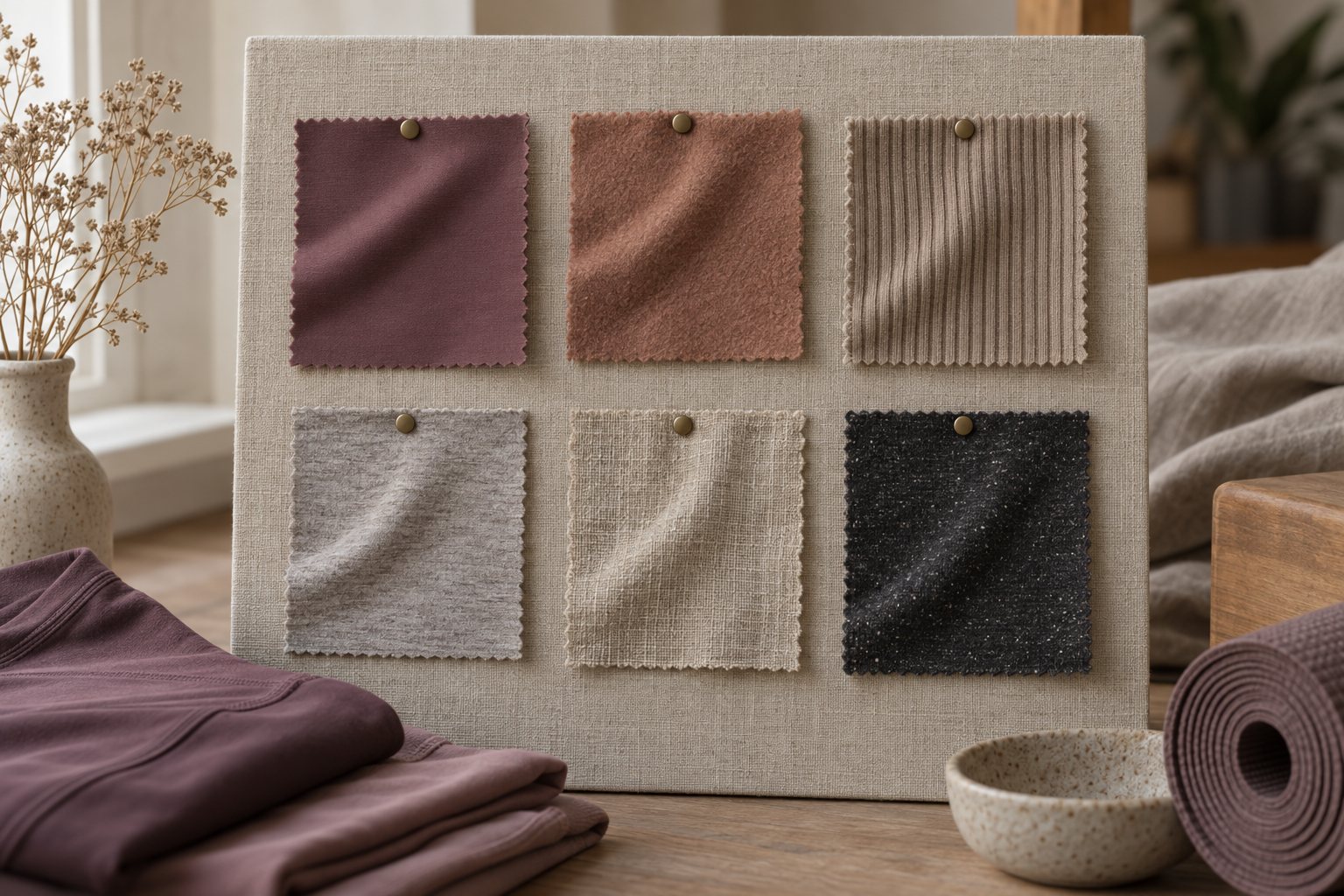
A short, honest comparison on two shortlisted fabrics usually settles the decision faster than reviewing a wide swatch book. Swatches show color and hand; only a sewn sample shows how the fabric behaves in the garment you will sell.
Keep cost in view while you compare. A heavier weight, a higher spandex share, a brushed finish or a certified recycled yarn each move the fabric cost, and fabric is usually the largest part of the unit price. If two fabrics perform similarly in your wear test, the simpler one often makes the stronger program. The cost side is explained on yoga wear pricing.
Choosing the best fabric for your line
Start from the garment and the practice: what the piece must do, how it is washed, and what your customer pays. Then shortlist two fabrics and compare them on the same style and color. Write the winning fabric into the tech pack with composition, weight and tests. GSM tolerance is usually about +/-5% of nominal, tested per ISO 3801 or ASTM D3776.
When you have a shortlist, send a brief and the desk will arrange swatches and a sampling plan.