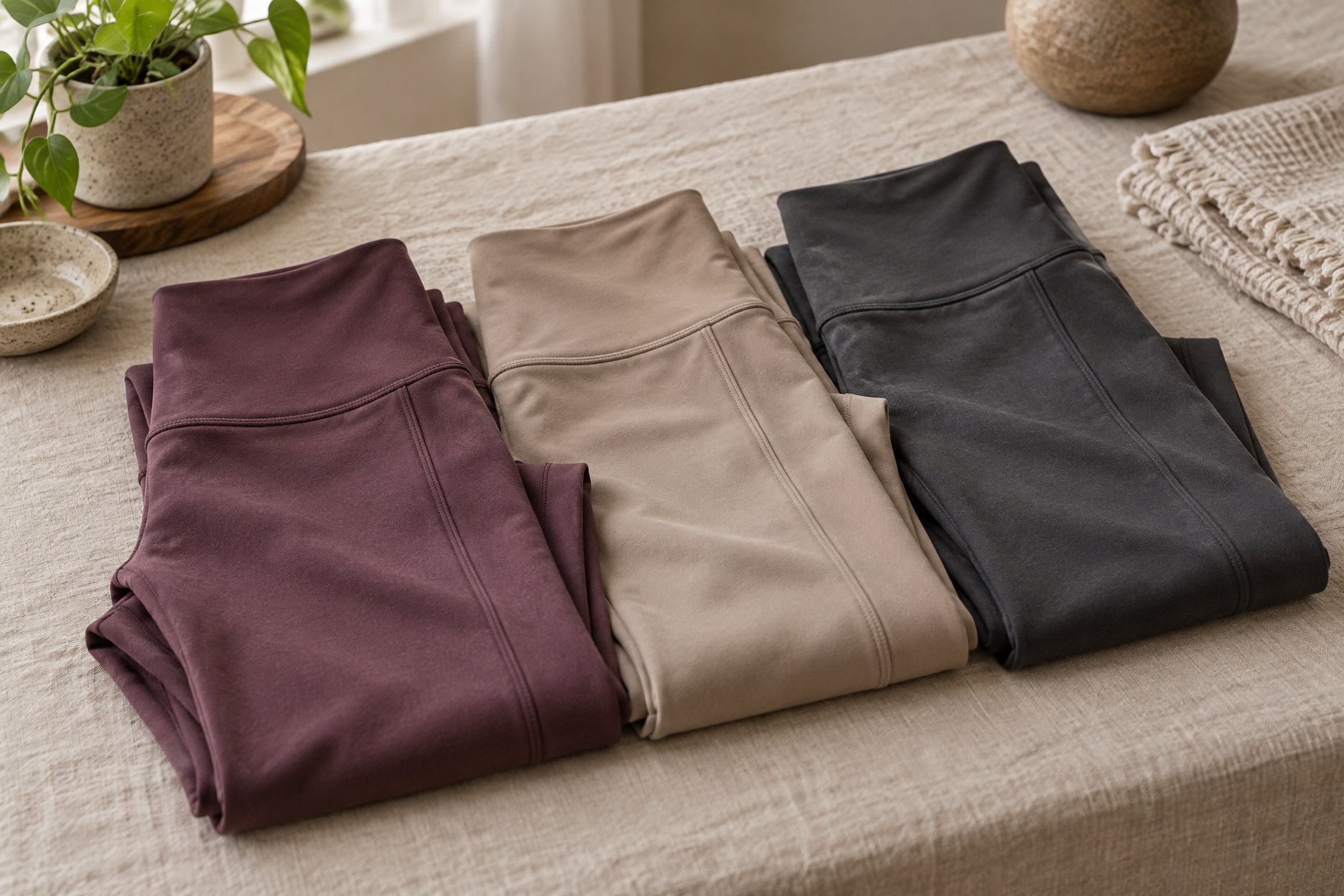
What a buyer is really specifying
A legging looks simple: two legs and a waistband. In practice a custom yoga leggings manufacturer has to agree with you on about a dozen decisions before the first sample, and each one affects fit, opacity, cost and MOQ. When those decisions are left open, the factory fills them with its own defaults, and the sample comes back as someone else's legging.
The desk works through the decisions below with you, writes them into the brief and tech pack, and passes them to the partner factory assigned to your program. Cut and sew leggings usually go to a partner in the Humen cluster; seamless leggings to a partner in the Yiwu cluster.
Rise and waistband
Most yoga wear leggings today are high-rise, with a waistband that sits at or above the natural waist. A common construction is a 3-layer waistband, with a reference height of about 4-6 in; the exact height is confirmed on the tech pack. Taller bands give more hold in forward folds but need a firmer elastic or a double layer so they do not roll.
Decide whether the waistband has an internal elastic, a fold-over construction with no elastic, or a bonded edge. Decide where the seam sits: a waistband without a center front seam looks cleaner, while a contoured back rise with a V or curved seam improves fit at the back. Our note on high-rise waistband construction compares the options.
Inseam and length options
Leggings are usually offered in two or three lengths. Common options are about 25 in for a 7/8 length and about 28 in for full length, with capri and bike lengths for warmer climates. These are common options, not fixed rules; the inseam for each size is confirmed on the tech pack. If you sell to a tall or petite customer, consider separate inseams rather than one length for all.
Gusset, pockets and seams
Gusset
A gusset is a small panel at the crotch that spreads stress and improves movement in wide stances. Diamond and triangle shapes are both common. A gusset also removes the four-way seam junction at the crotch, which is a frequent failure and comfort point. See gusset design for shape choices.
Pockets
Options include a hidden waistband pocket for a key or card and side drop-in pockets on the thigh that fit a phone. Side pockets add panels and operations, and they need the pocket bag to be cut in the same dye lot so the color matches. Pockets also move a legging firmly into the cut and sew route.
Seam types
| Seam | What it is | Where it fits |
|---|---|---|
| Flatlock | Flat, butted seam with stitches on both sides | Leg seams, gussets; durable and low profile |
| Coverstitch | Top stitches over a folded or joined edge | Hems, waistband attachment, clean finishes |
| Bonded / laser-cut | Edges cut clean and bonded with tape, no stitch | Hems and pocket openings on minimal styles |
| Seamless knit | Knitted tube with programmed zones, few seams | Ribbed or textured leggings from the Yiwu route |
Bonded edges look clean but need careful testing after washing. Flatlock is the durable default for most studio leggings.
Fabric and opacity
Premium leggings usually use nylon/spandex interlock at about 75-80% nylon and 20-25% spandex, in the 230-280 GSM range. Brushed nylon/spandex gives the soft, "buttery" handfeel; brushing can add weight, so ask for base and finished GSM. Polyester/spandex costs less and is the usual base for sublimation prints. About 15% spandex reads as comfort stretch; 25% and above as high compression.
Opacity is the most common complaint about leggings. Dark colors may pass at 230-240 GSM, while white and pastel shades often need 280-300 GSM. The squat test is a practical review of the sample under stretch and light, not an official standard, but it catches most problems before bulk. Read the squat-proof test guide and the fabric library.
Spec sheet fields for leggings
- Fabric: fiber composition, finished GSM, finish (brushed or smooth), colors and dye method.
- Measurements per size: waist relaxed and extended, hip, front and back rise, thigh, knee, leg opening, inseam, waistband height.
- Tolerances per measurement, so the factory knows what passes.
- Construction: seam type per seam, gusset shape, waistband build, pocket positions.
- Trims and branding: logo method and position, labels, care label, hang tag, polybag.
- Tests requested, for example colorfastness, pilling and stretch and growth (ASTM D2594).
Our spec sheet guide has the full field list.
Common legging problems to design out
Most legging complaints trace back to a handful of causes, and almost all of them can be caught at the sample stage if the review is structured.
- Waistband rolling. Usually an elastic that is too soft for the band height, or a band cut without enough negative ease. Review the sample in a seated forward fold and after washing.
- Sheerness at the seat. Usually fabric that is too light for the color, or a pattern that stretches the seat more than the fabric allows. Check finished GSM and repeat the squat review in every color, not only black.
- Bagging at the knee. Often a sign of low spandex share or poor recovery. Stretch and growth testing per ASTM D2594 shows how much the fabric fails to return after extension.
- Pilling on the inner thigh. Abrasion between the legs wears the surface. Ask for pilling results (ASTM D4970 or ISO 12945-2) and consider an anti-pilling finish.
- Shrinkage after washing. Dimensional change per AATCC 135 should be checked on the bulk fabric, especially on brushed qualities.
Writing these checkpoints into the approval step costs little and saves a reorder that would otherwise carry the same flaw. See quality control for how the desk schedules inspections.
MOQ, sampling and lead time
Cut and sew leggings typically start at 100-300 pcs per style per color; seamless leggings typically at 300-500 pcs. Sizes can usually be mixed within the color quantity. First samples typically take 7-15 days and bulk typically 30-45 days after sample approval and fabric availability. All figures are confirmed in writing for each program. See MOQ and lead time, or send your legging brief.