Who is responsible for what
In most markets the importer or brand owner is responsible for the product it places on the market. A sourcing desk can help select tests, arrange them and organize the paperwork, but the legal responsibility stays with the seller. SutraKnit does not hold product certificates, and we never state that a fabric or factory holds a certificate unless it has been shown and checked. This page explains what to ask for and how to check it.
Laboratory tests worth requesting
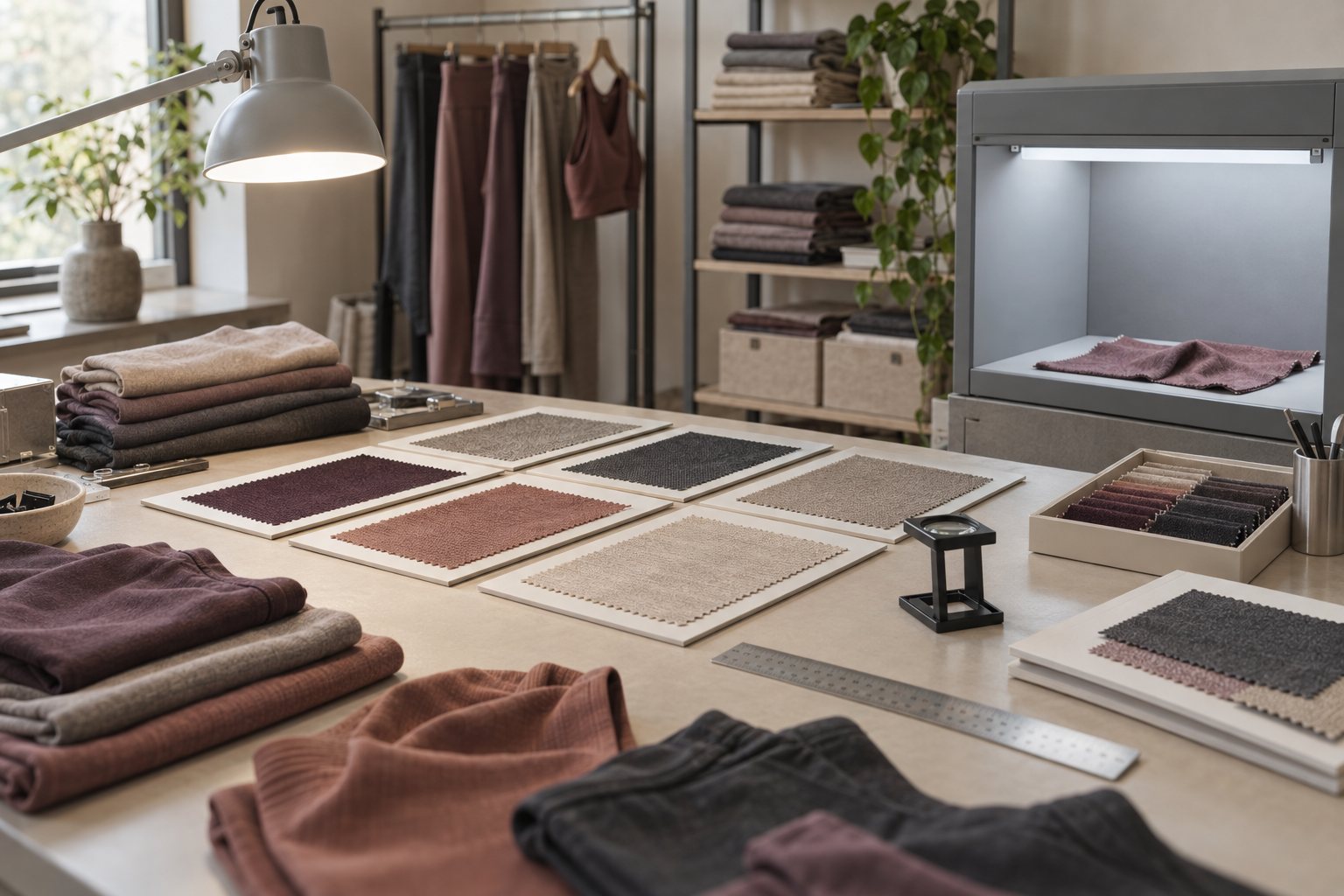
Not every program needs every test. The ledger below lists the methods commonly used for yoga apparel and when each one is relevant. Tests are run on the actual dyed and finished fabric, or on finished garments, by a laboratory agreed in the order terms.
| Property | Common methods | Why it matters for yoga wear |
|---|---|---|
| Colorfastness to laundering | AATCC 61 | Frequent washing; color loss at seat and thigh |
| Colorfastness to perspiration | AATCC 15, ISO 105-E04 | Sweat contact in hot and vigorous classes; grade 3-4 is a common acceptance |
| Colorfastness to crocking | AATCC 8 | Dark colors rubbing onto mats, bags and light tops |
| Colorfastness to light | AATCC 16.3, ISO 105-B02 | Outdoor practice and shop window display |
| Dimensional change | AATCC 135 | Shrinkage after laundering; affects fit |
| Pilling | ASTM D4970, ISO 12945-2, ASTM D3512 | Inner thigh abrasion, especially on brushed fabrics |
| Stretch and growth | ASTM D2594 | Recovery; bagging at the knee and seat |
| Fabric weight | ASTM D3776, ISO 3801 | Confirms GSM against the fabric sheet |
| Bursting strength | ASTM D3786 | Knit strength under multi-directional stress |
| Moisture management | AATCC 195 | Supports any wicking claim on the label or product page |
The squat or opacity check is a practical sample review method, not an official standard. It belongs in the sample and inspection plan rather than the lab report. See colorfastness testing and stretch and recovery testing for detail.
Certification schemes and what they cover
Certificates are held by a mill, a factory or a supply chain, not by a style in isolation. Where the mill or factory for your program holds one, the certificate is available on request and verified by number.
- OEKO-TEX STANDARD 100 - tests for harmful substances. Certificates are issued by product class: class I covers articles for babies, class II covers articles with skin contact, which is where most yoga wear sits. See OEKO-TEX for activewear.
- GOTS - organic textiles. Products labeled "organic" need at least 95% certified organic fiber; "made with organic" needs at least 70%.
- GRS - recycled content. The scheme covers products with at least 20% recycled material, and use of the GRS label requires at least 50%.
- bluesign - a chemical management system for mills and their inputs.
- amfori BSCI, SMETA (Sedex), WRAP - social audits of factories, covering working conditions. These are audits, not product certificates.
How to verify a certificate
- Ask for the certificate itself - not a logo on a website or a hang tag sample.
- Read the holder and scope - the certificate holder should be the mill or factory in your program, and the scope should cover the material or product type you are buying.
- Check validity - certificates expire. Note the validity date against your production dates.
- Look it up by number - each scheme offers a lookup on its own website where the certificate number can be checked. If the number does not return a matching holder and scope, treat the certificate as unverified.
- For GOTS and GRS, ask about transaction certificates - these link a specific shipment to the certified supply chain.
US rules buyers must handle
Labeling
The Textile Fiber Products Identification Act, implemented in 16 CFR 303, requires fiber content by percentage, country of origin and the identity of the dealer, often by RN number. The Care Labeling Rule, 16 CFR 423, requires care instructions. See US labeling rules.
Flammability
The Standard for the Flammability of Clothing Textiles, 16 CFR 1610, applies to clothing textiles. Certain fabrics are exempt from testing, for example plain-surface fabrics of 2.6 oz/yd2 or more, and fabrics made entirely of nylon, polyester, acrylic, modacrylic, olefin or wool. Blends and brushed surfaces should be checked case by case.
Children's products
Yoga wear designed for children 12 and under falls under the CPSIA. That means third-party testing by a CPSC-accepted laboratory, a Children's Product Certificate, tracking labels, a total lead content limit of 100 ppm and phthalate limits where relevant. See the kids yoga wear page.
California Proposition 65
Products sold in California need a warning where listed chemicals are present above the relevant thresholds. Testing and supplier declarations help decide whether a warning is needed.
PFAS state laws
California AB 1817 restricts intentionally added PFAS in textile articles from 2025, and other states have similar laws. Water-repellent and some stain-resistant finishes are the usual concern. Check current state requirements before launch.
Environmental claims
The FTC Green Guides discourage unqualified claims such as "eco-friendly" or "sustainable". Bamboo-derived fiber must be labeled as rayon or viscose made from bamboo.
Building a test plan for a program
A practical test plan starts from the claims you intend to make and the markets you sell in. If the product page says the legging is squat-tested, document the sample review. If it says moisture-wicking, a moisture management result supports it. If you sell children's sizes in the US, CPSIA testing is required rather than optional. Then add the durability tests that protect your returns rate: colorfastness, pilling and dimensional change on the lightest and darkest colors. The agreed plan, the laboratory and who arranges testing are written into the order terms before bulk fabric is dyed.
List the tests and markets in your brief so they are written into the order terms from the start.