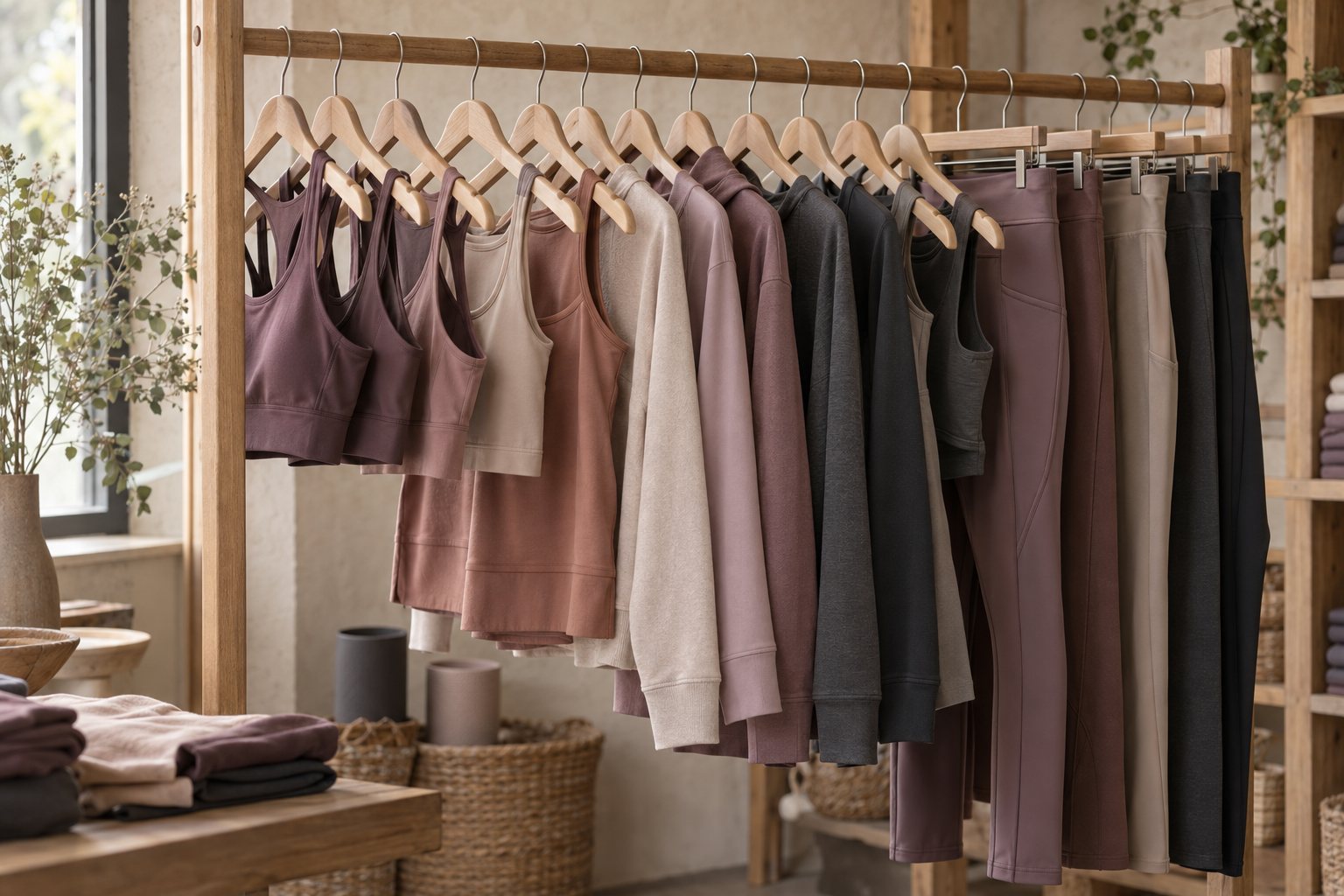
Start from the customer, not the catalog
Women buy yoga clothes for different practices and different bodies: a student in a heated vinyasa class, a pilates regular, a teacher who wears the same pieces all day, an older customer who wants coverage and comfort. A range that tries to serve all of them with the same legging usually serves none of them well. Decide first who the core customer is, then build out from there.
We coordinate development with partner factories in two routes, seamless and cut and sew, so the range can mix knit-in textures with pocketed, printed or extended-size styles.
Core styles
| Category | Role in the range | Typical route | Key decisions |
|---|---|---|---|
| Leggings | Anchor product, highest volume | Cut and sew or seamless | Fabric, waistband height, inseam, pockets |
| Sports bras | Pairs with leggings, drives sets | Cut and sew or seamless | Support level, cups, back style |
| Tops | Layering and coverage | Cut and sew | Length, neckline, fabric weight |
| Shorts | Hot classes and summer | Cut and sew | Inseam, liner, leg grip |
| Sets and one-pieces | Higher basket value | Seamless or cut and sew | Color matching across pieces |
| Loose pieces | Meditation, restorative, travel | Cut and sew | Cotton or modal feel, drape |
Most first collections pick two or three categories and do them well. See yoga leggings and sports bras for construction detail on the two anchor products.
Size range
Set a core size run that covers your main customer, then decide which extensions are worth the development time. Sizes can usually be mixed within the MOQ, so a wider run does not automatically mean a larger order, but every extra size adds fit checks and grade rules. Extended sizes need their own fit work rather than a simple scale-up; see plus-size yoga wear.
Inseam options
Length is one of the most common reasons for returns. Offering petite and tall inseams as options, rather than separate styles, keeps the range compact. Common options include a 25 in 7/8 length and a 28 in full length, with other lengths confirmed on the tech pack. Our article on inseam and length options explains how to set them.
Fit for older women
Yoga clothes for older ladies are a real and under-served segment. The needs are practical rather than special: more coverage, a waistband that holds without digging, softer fabrics and easier care.
- Coverage. Higher rise at the back, longer tops that cover the seat, and opaque fabrics checked with the squat test.
- Waistband comfort. A wider, softer band with moderate compression rather than a tight high-compression band. Height is confirmed on the tech pack.
- Fabric. Brushed nylon/spandex or a cotton or modal blend with a comfortable spandex share, around 15% for comfort rather than 25%+ for high compression.
- Ease of dressing. Bras with front-adjustable straps or wider bands, and tops with relaxed armholes.
Avoid any body-shaping language. Describe comfort, coverage and fabric instead. Read more in yoga clothes for older women.
Color architecture
Plan colors in layers. A small set of core colors, usually darks and neutrals, runs across every style and is reordered. Seasonal colors add freshness on a few styles. Accent colors appear on one or two pieces to lift a set. This keeps the number of style-color combinations under control, which matters because MOQs are set per style per color.
Assortment depth
Depth is the number of pieces per style and color. A wide range with thin depth sells out of core sizes quickly and leaves odd sizes behind. A narrow range with good depth is easier to reorder. On cut and sew, the typical reference MOQ is 100-300 pcs per style per color; on seamless it is 300-500 pcs. Both are confirmed in writing for each program. Use those floors to decide how many style-color combinations your budget can carry at sensible depth.
Example structure (illustrative)
An illustrative first range could be two legging styles in three core colors, one bra in the same colors, and one top in two colors. That is a focused set that can be photographed together and reordered by color. It is an example, not a recommendation for every brand.
Where to add depth and where to stay lean
Put depth behind the anchor legging in core dark colors, because that is where reorders come from. Keep fashion colors, statement backs and new fabrics lean until they prove themselves. Sets deserve special care: if a customer can buy the legging but the matching bra is sold out in her size, both pieces stall. Plan matching pieces with compatible size ratios so they sell through together.
Fabric choices across the range
A women's range rarely uses one fabric for everything. A smooth nylon/spandex interlock in the 230-280 GSM range suits performance leggings and bras. A brushed nylon/spandex gives a softer hand for low-impact classes and older customers. A cotton or modal blend suits loose tops and meditation pieces. Using a small number of fabrics across several styles keeps fabric minimums manageable and makes color matching easier. Each fabric is confirmed on its fabric sheet with composition, weight and tests.
Development calendar
First samples typically take 7-15 days, and bulk typically 30-45 days after sample approval and fabric availability. A women's range with several categories usually needs two sampling rounds for fit. Work backwards from your launch date and leave room for a second round. Details are on MOQ and lead time.
What to send
- Your target customer and the practices you are designing for.
- Reference styles for each category and your preferred fabrics.
- The size run, including any plus or inseam options.
- Your color plan and target quantities per style.
The desk will reply with a route per style, reference MOQs and a sampling plan. Send a brief when ready.