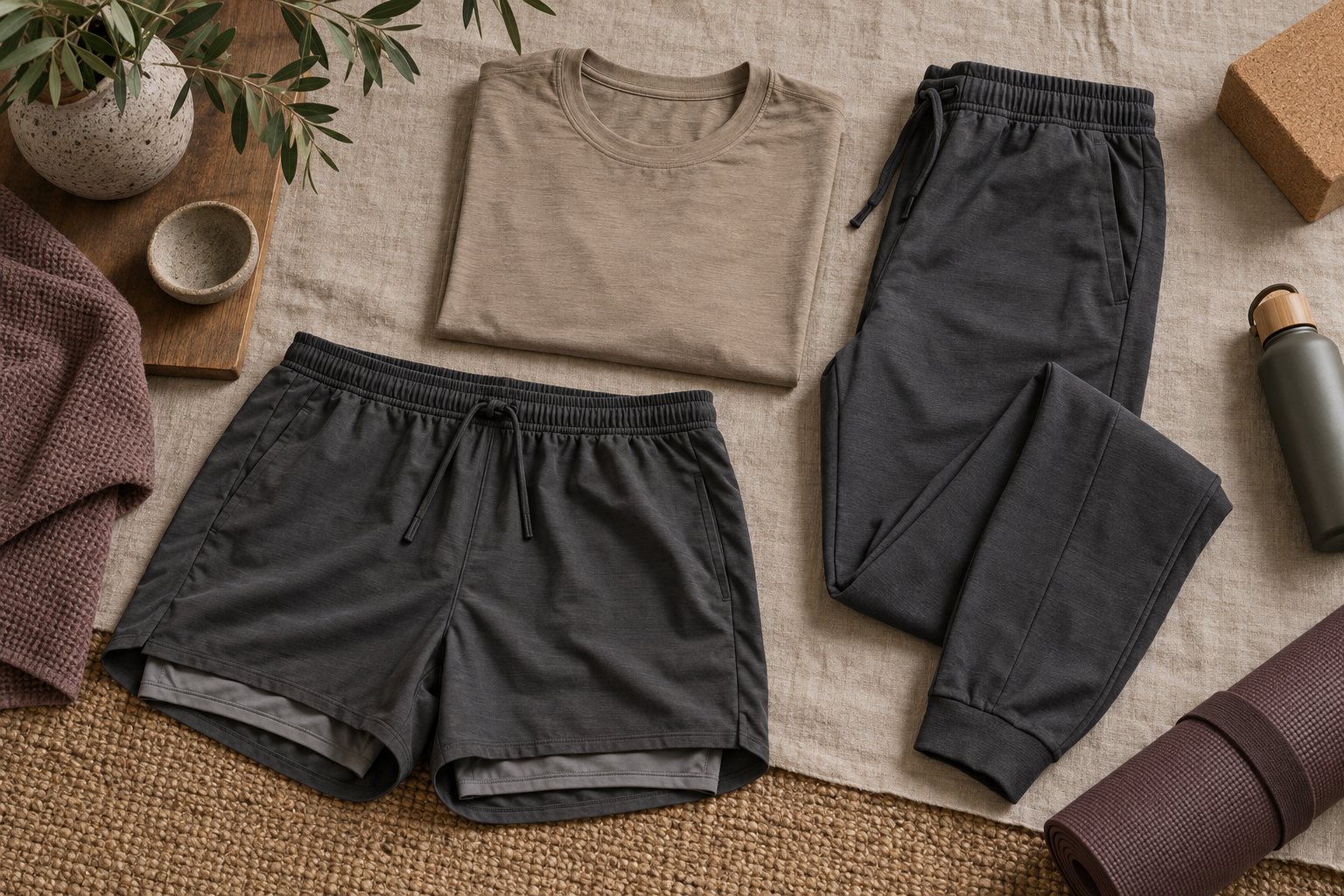
Why men's yoga wear needs its own brief
Men's yoga apparel is a smaller category than women's, but it is growing in studios, in wellness retail and in corporate programs. The customer usually wants clothes that move in deep stances, do not ride up or gape in inversions, and look acceptable outside the studio. Few men want a high-compression legging as their only option; many want shorts with liners and tapered pants.
The construction differs from women's styles in rise, crotch shape, liner support and pocket design. Writing those differences into the brief avoids a first sample that is simply a resized women's pattern. Most men's yoga wear goes to a cut and sew partner in the Humen cluster, where shorts with liners, woven shells and pockets are routine.
Men's line ledger
| Garment | Typical fabric | Key decisions |
|---|---|---|
| Shorts with liner | Polyester/spandex or nylon/spandex shell, knit liner | Liner type and support, inseam, zip or secure pocket, side split |
| Joggers | Brushed knit, polyester/spandex, cotton blend | Cuff, rise, gusset, drawcord or elastic waist |
| Tapered pants | Lightweight stretch woven or knit | Taper, rise, gusset, hem finish |
| Fitted tights | Nylon/spandex interlock | Front rise, gusset, opacity, worn alone or under shorts |
| Tees and tanks | Polyester/spandex, modal or cotton blends | Length, armhole, fit, quick drying |
Shorts with liners
Shorts are the core of most men's yoga lines. The liner does the work of underwear and keeps coverage when the outer shell moves in seated and inverted poses. Liner options include a brief liner, a short compression liner and a longer fitted liner that doubles as a tight. Each changes support, warmth and price.
Points to specify:
- Liner type, length and fabric, and how it attaches to the shell.
- Inseam of the shell and of the liner; common options are set on the tech pack.
- A secure pocket, such as a zip pocket or a liner phone pocket, because loose items fall out in inversions.
- Side splits or a shaped hem to free the knee in wide stances.
Our note on liners, inseams and leg openings covers the detail.
Rise and gusset for men
Men's pants and shorts need a longer front rise and a different crotch shape than women's. Without a gusset, a men's pant pulls at the crotch in a wide-legged forward fold and wears through at the four-way seam junction. A diamond or triangle gusset solves both problems and is standard on well-made men's yoga pants. The gusset design note compares shapes.
Rise height, waistband construction and the gusset shape are confirmed on the tech pack. Many men's styles use a flat elastic waistband with an internal drawcord, which lets the wearer adjust fit without a high-compression band.
Joggers and tapered pants
Joggers have a cuffed ankle and a relaxed thigh, and they suit warm-up, cool-down and travel to the studio. Tapered pants narrow toward the ankle without a cuff, and they suit practice where a cuff could catch. Both need enough room through the seat and thigh to sit cross-legged, and both benefit from a gusset.
Fabric choice sets the character. A brushed knit is warm and casual. A lightweight stretch woven feels technical and dries fast. A cotton blend feels familiar but holds sweat. Check dimensional change after laundering (AATCC 135) on cotton-rich fabrics, because shrinkage shortens the inseam.
Tees and tanks
Men's tops for yoga are usually a slim but not tight fit, with enough body length that the hem does not ride up in downward dog. Polyester/spandex dries fast and holds color. Modal and cotton blends feel softer and suit layering. If you use fiber made from bamboo, label it as viscose made from bamboo in line with FTC guidance.
Fabric choices for a men's line
Polyester/spandex is a common base for men's shorts and tops because it is durable, holds color and takes prints. Nylon/spandex gives a smoother, softer hand and suits tights and liners. Spandex share is usually lower in men's shells than in women's leggings, because the shell is meant to move freely rather than compress. The fabric library lists reference compositions and weights.
Sizing for men
Men's sizing runs on waist, hip, inseam and chest, often in S-XXL letter sizes. Inseam options matter more for men's pants than for women's leggings, because men's pants are less forgiving in length. Grade rules for rise and thigh should be set from a men's fit model, not converted from a women's chart.
Building the range
A first men's line often starts with one lined short in two lengths, one jogger or tapered pant and one tee, in two or three neutral colors. That covers practice, warm-up and wear outside the studio. Studios often add the same styles to teacher uniform programs. Our men's yoga clothes product line note covers range planning.
Testing and sample review for men's styles
Men's shorts and pants take heavy abrasion at the inner thigh and seat, so pilling resistance (ASTM D4970 or ISO 12945-2) and bursting strength (ASTM D3786) for knit shells are sensible requests. Colorfastness to perspiration (AATCC 15 or ISO 105-E04) matters on dark tees and tanks. At the sample stage, review the fit in a wide-legged forward fold, a seated cross-legged position and an inversion: check that the shell does not gape, the liner stays flat and pocket contents stay put. Approve the sample only after those checks pass, and keep it as the reference for bulk inspection.
MOQ and timeline
Men's cut and sew styles typically start at 100-300 pcs per style per color, with sizes usually mixable within the color quantity. First samples typically take 7-15 days and bulk typically 30-45 days after sample approval and fabric availability. All figures are confirmed in writing for each program. Read MOQ and lead time, then send a men's brief.