What "seamless" means in practice
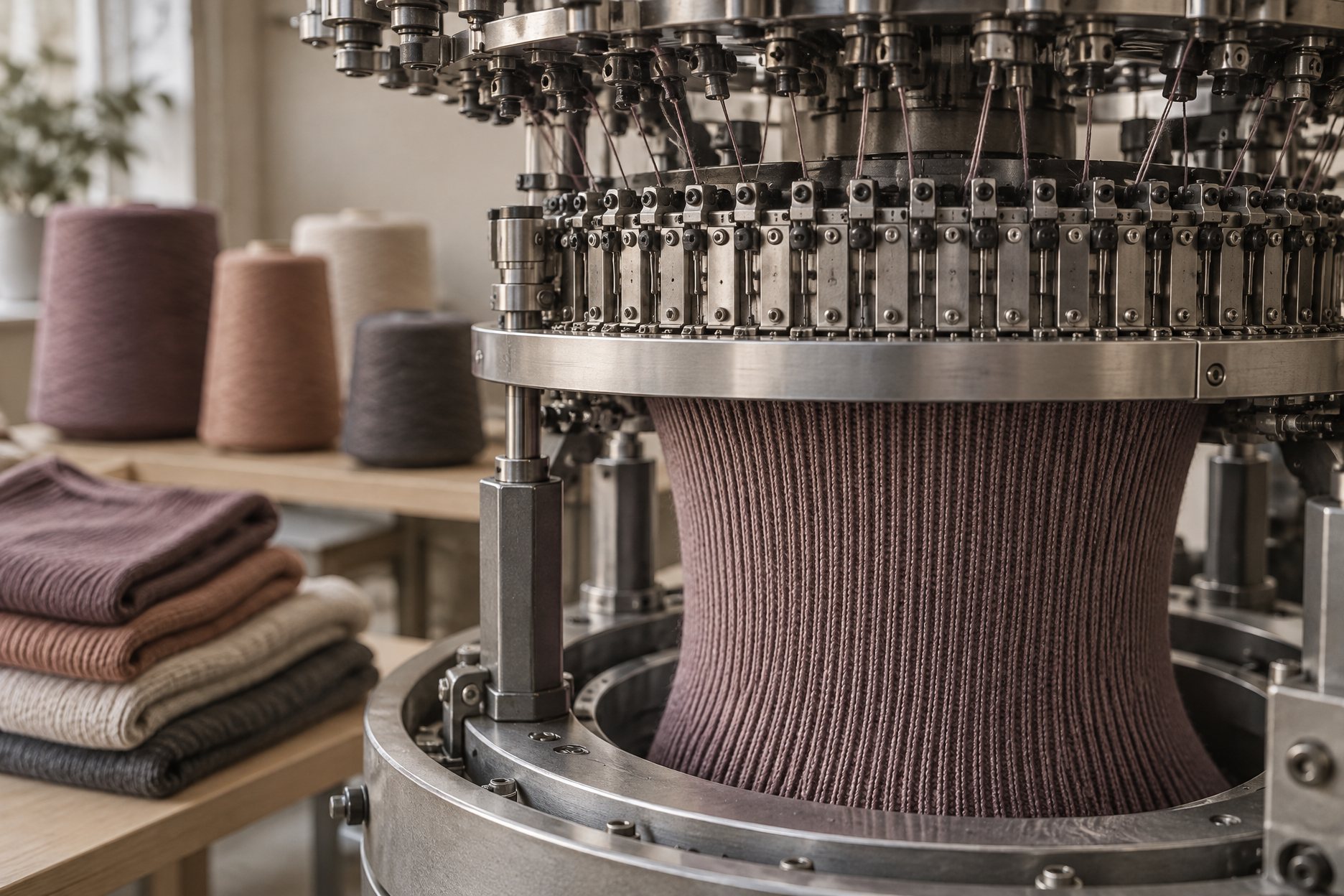
A seamless garment is knitted on an electronic circular seamless knitting machine as a tube that is already close to the shape of the body. Instead of cutting panels from a roll of fabric and sewing them together, the machine knits the waistband, leg and texture in one continuous piece. A few finishing seams remain, usually at the crotch or the ends of the tube, but the long side seams of a cut and sew legging disappear.
The result is a garment with a smooth, uninterrupted line and texture that is built in rather than printed or sewn on. Ribbed sets, contour leggings, seamless bras and one-piece suits are typical seamless products.
The Yiwu cluster
We coordinate seamless programs with partner factories in the Yiwu area of Zhejiang. A 2024 press report described several hundred yoga-apparel businesses there, many of them converted from leggings and hosiery knitting in recent years. That background matters: the knitting skills and machine base come from a long tradition of tube knitting. Factory capabilities are documented per factory profile rather than as cluster statistics. Read more about the Yiwu seamless cluster.
How a seamless garment is made
- Yarn selection and dyeing - nylon and spandex yarns are chosen and usually dyed before knitting, which is why color planning happens early.
- Knitting program - a technician writes a program for the style that defines the tube, waistband, rib or mesh zones and the size.
- Tube knitting - the machine knits the garment blank as a continuous tube with the zones built in.
- Minimal cut and sew finishing - the blank is closed at the crotch or edges, and any straps, cups or labels are added.
- Setting and finishing - steaming or setting stabilizes the shape and size before inspection.
- Inspection and packing - measurements, texture and color are checked against the approved sample.
Knit-in zones
The real advantage of seamless is body mapping. The machine can change stitch structure within the same garment: firmer compression at the waist, rib texture on the legs, open mesh behind the knee or under the bust, and contour lines that shape the seat. These zones are part of the knitting program, so they repeat precisely from piece to piece once the program is approved. Describe the zones you want on the tech pack with a marked-up sketch, and expect the technician to suggest adjustments that suit the machine gauge.
Seamless versus cut and sew
| Factor | Seamless (Yiwu cluster) | Cut and sew (Humen cluster) |
|---|---|---|
| Typical MOQ per style per color | 300-500 pcs, reference range | 100-300 pcs, reference range |
| Look | Knit-in rib, mesh and contour texture | Smooth panels, prints, color blocking |
| Seams | Few finishing seams | Flatlock or coverstitch seams |
| Pockets and gussets | Limited | Easy to add |
| Size range | Each size or size group needs its own program | Graded patterns cover wider ranges |
| Change a detail | Rewrite the knitting program | Adjust the pattern |
All MOQs and lead times are confirmed in writing for each program. Our article on seamless vs cut and sew goes deeper.
Strengths and limits
Strengths
- A clean silhouette with fewer seams to chafe.
- Texture and compression zones that cannot be copied with a print.
- Stable repeat production once the program is approved.
Limits
- A higher MOQ, because each style needs machine setup and a program before good pieces come off.
- Fewer options for pockets, gussets and removable cups.
- A narrower stretch of sizes per program; extended sizes may need separate development.
- Prints and fine color blocking are harder; colors are usually yarn-dyed.
Typical seamless products
Ribbed sets. A ribbed legging and matching bra are the classic seamless set. Color matching between pieces is easier because both are knitted from the same yarn lot; see yoga sets.
Seamless bras. Knitted bras with built-in support zones and an option for pads. Support level is set by structure and spandex share rather than by sewn panels.
One-piece suits. Seamless bodysuits and unitards benefit from the continuous knit, though torso length and size range need careful sampling. See one-piece yoga suits.
Development steps and calendar
Seamless development starts with a reference sample or a detailed sketch, the yarn composition and the color. The technician writes the program and knits a first sample, typically within 7-15 days once the program is written. Expect at least one round of adjustment for length, compression and size. Bulk typically takes 30-45 days after sample approval, including yarn dyeing. These are typical reference ranges and are confirmed in writing for each program.
What to check on a seamless sample
- Length and rise - seamless tubes relax after setting, so measure after steaming, not straight off the machine.
- Compression feel - wear the sample for a full class; zones that feel firm in the mirror can feel tight after an hour.
- Opacity - rib and mesh zones open up under stretch; repeat the squat check on textured areas.
- Stretch and recovery - ASTM D2594 describes stretch and growth of knitted fabrics if you want a lab result.
- Color between pieces - for sets, compare legging and bra under the same light.
Record comments against the size and the zone, with photos, so the technician can adjust the program precisely rather than guessing from a general remark.
When seamless is the right route
Choose seamless when the texture or contour is the selling point and when you can commit to the deeper quantity per style. Choose cut and sew when you need pockets, prints, extended sizes or small runs. Many brands combine both: seamless sets alongside cut and sew leggings with pockets. Check MOQ and lead time for both routes, or send a brief with your reference styles.