The job of a yoga bra
A running bra controls vertical bounce. A yoga sports bra has a different job: it has to stay put through inversions and twists, keep the neckline in place in a forward fold, and stay comfortable for an hour of slow holds. For pilates reformer work the back has to lie flat against the carriage. These needs shape the support level, the strap layout and the cup choice.
The desk turns those needs into a written brief before sampling. As a yoga sports bra manufacturer partner, the factory assigned to your program then proposes fabric, cup and elastic options that fit the route. Cut and sew bras with removable pads usually go to a partner in the Humen cluster; ribbed seamless bras to a partner in the Yiwu cluster.
Support levels
| Support level | Typical use | Typical construction |
|---|---|---|
| Light | Yin, restorative, slow flow, lounge | Single or double layer, thin straps, soft underband, optional pads |
| Medium | Vinyasa, pilates, hot yoga, studio classes | Double layer, wider underband, removable pads or molded cups, racerback or cross-back |
| High | Training and running crossover | Firmer fabric, encapsulating cups, adjustable straps, often hook back |
Most yoga lines live at light and medium support. Support is a combination of fabric compression, underband width, strap layout and cup structure; it is evaluated on the sample on real bodies, not promised by a single number. Our note on sports bra support levels explains how to describe support on a tech pack.
Removable or molded cups
Removable pads
Removable pads slide into a pocket between the lining and shell. They let the wearer choose coverage, they dry faster when removed, and they suit a cut and sew bra. The weak points are pads that fold or shift in the wash, and pad openings that are too large or too small. Specify the pad shape, thickness and the opening position so the pad sits flat.
Molded cups
Molded cups are formed foam cups sewn or bonded in place. They give a smooth shape under thin fabric and do not shift, but they come in fixed shapes, so they need careful size grading. A new molded cup shape has its own supplier minimum and lead time, which can set the floor for your order. The removable vs molded cups note compares both in detail.
Straps, backs and underband
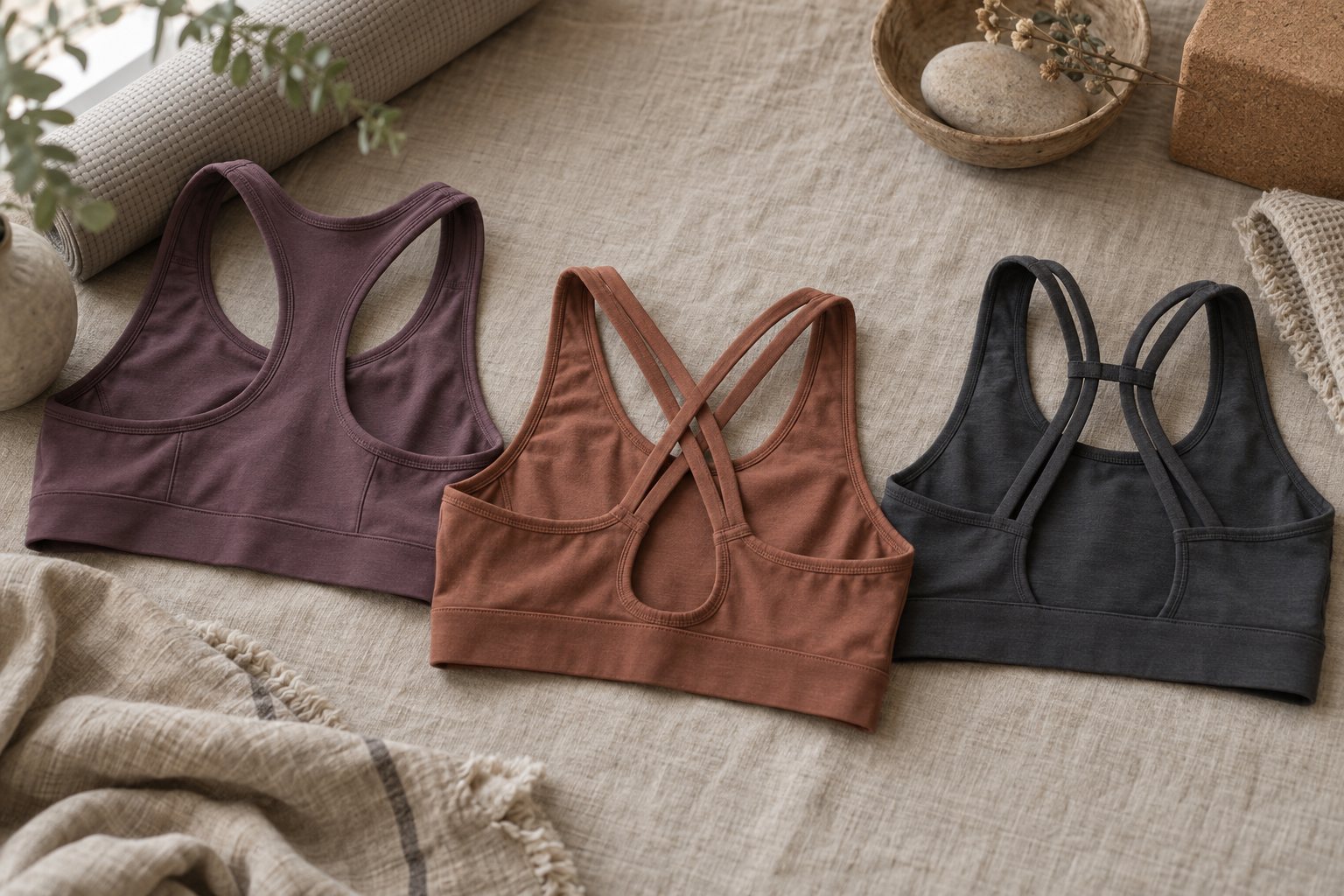
Back styles carry much of the design identity: racerback, cross-back, strappy multi-strap layouts, keyhole backs and open backs. Each one changes support. A racerback pulls straps toward the center and stays put in arm balances. A cross-back spreads load. Thin strappy designs look light but need firm anchoring at the underband.
The underband does most of the support work. A wider underband with a soft elastic or a knitted band gives hold without digging in. Decide whether the band is a separate elastic, a fold-over knit band or a seamless knitted zone. On longline bras, which extend toward the waist, check that the band does not roll during forward folds.
Seamless or cut and sew bras
Seamless bras are knitted on electronic circular seamless knitting machines, often with ribbed texture and programmed compression zones. They feel soft and have few seams, which suits light to medium support and matching ribbed sets. Each style needs its own knitting program, so seamless MOQs are typically 300-500 pcs per style per color.
Cut and sew bras use nylon/spandex fabric cut into panels with a lining, which allows color blocking, prints, removable pads and exact strap placement. Cut and sew MOQs are typically 100-300 pcs per style per color. Both figures are reference ranges, confirmed in writing for each program. See seamless yoga wear for the trade-offs.
Sizing: S-XL or bra sizes
Most yoga bras are sold in letter sizes, often S-XL, sometimes extended. Letter sizing keeps the size run short and works for light and medium support. Band and cup sizing gives a better fit for fuller busts and for medium to high support, but it multiplies the number of sizes, and each size needs stock in each color.
A middle path is letter sizes with separate cup options for the larger sizes, or extended letter sizes for a plus range. Whatever you choose, write the size chart and the grade rules before sampling. Our size chart and grading note covers how to set them.
Spec sheet fields for bras
- Fabric for shell and lining: composition, GSM and finish.
- Support level and intended practice.
- Cup type: removable pad shape and thickness, or molded cup reference.
- Measurements per size: underband relaxed and extended, chest, strap length, front and back length.
- Back style, strap width and attachment, adjustability.
- Tests: colorfastness to perspiration (AATCC 15 or ISO 105-E04) and to laundering (AATCC 61).
Fabric and color decisions for bras
Bras usually share their shell fabric with the matching legging, so the two pieces dye in the same lot and match on the shelf. The lining is often a lighter knit, chosen for softness against the skin and quick drying. A bra in a light color needs the same opacity attention as a legging: pads can show through a thin white shell, and the lining color should be agreed so it does not shadow.
Colorfastness matters more on bras than on most garments, because the fabric sits under straps and against skin that sweats. Perspiration testing to AATCC 15 or ISO 105-E04, where grade 3-4 is a common acceptance, is worth requesting on dark and bright shades. For the fabric reference ranges, see the fabric library.
MOQ, sampling and bulk timing
Bras often need one more sampling round than leggings, because support and cup position are judged on fit, not only on measurements. Plan for that in the calendar. A first sample typically takes 7-15 days, and bulk typically takes 30-45 days after sample approval and fabric availability. A new molded cup shape may add its own lead time. All figures are confirmed in writing for each program; see MOQ and lead time.
When the brief is ready, send it to the desk.