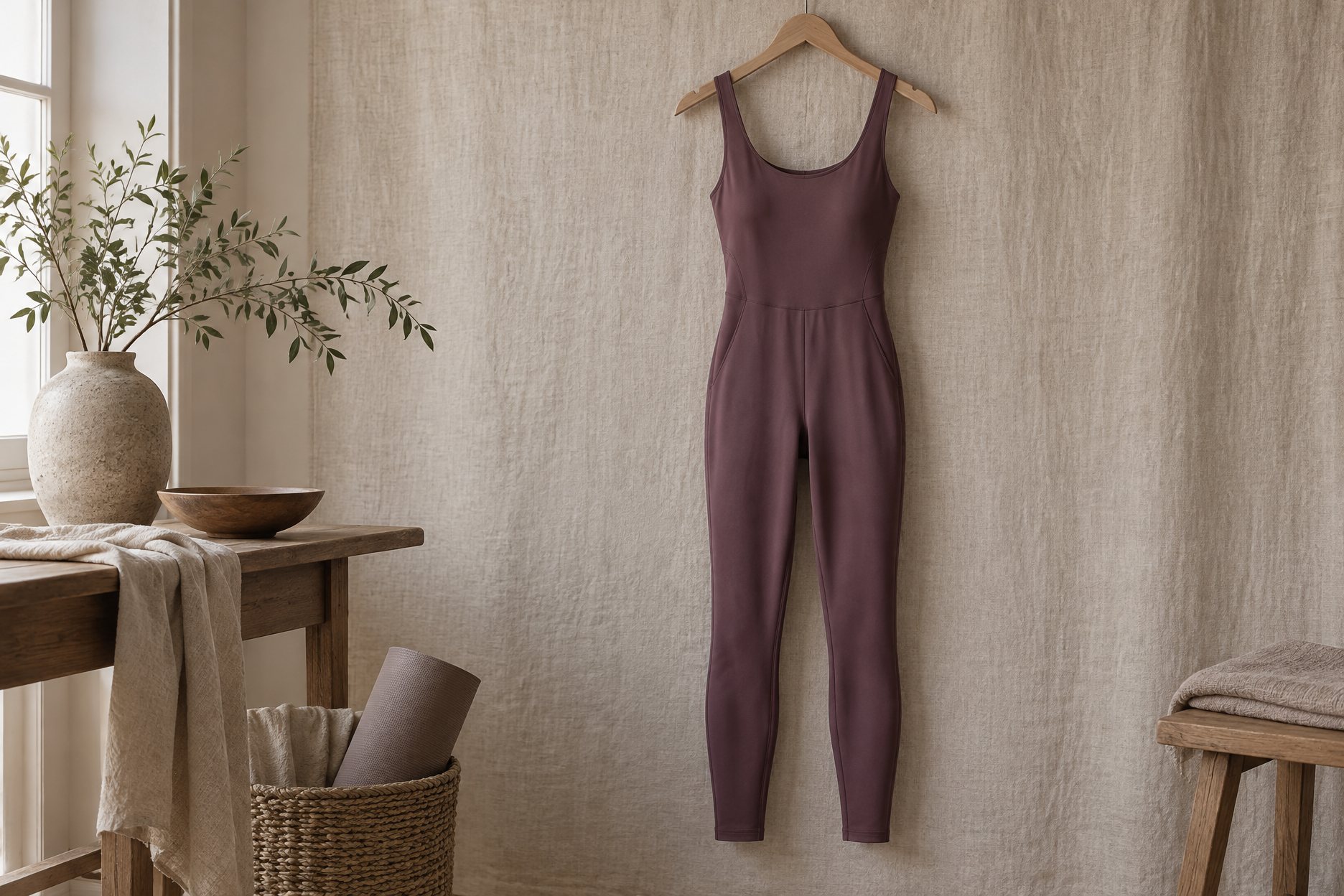
What counts as a one-piece yoga suit
Buyers use several names for the same family. A yoga jumpsuit or unitard usually means a fitted one-piece from shoulder to ankle or to 7/8 length. A short unitard ends at bike-short length. A bodysuit ends at the hip like a leotard and is often worn with leggings. Some sellers use "onesie" for the same garments. On a tech pack, the name matters less than the length, the neckline, the back style and the closure.
One-piece suits sell well in studios and on social media because they look finished with nothing else. They are also harder to fit than separates, because a single garment must suit both the torso length and the leg length of the wearer.
Style options
| Style | Length | Typical features | Usual route |
|---|---|---|---|
| Full-length jumpsuit | Ankle | Scoop or open back, built-in bra, optional pockets | Seamless or cut and sew |
| 7/8 unitard | Above ankle | Ribbed or smooth knit, racerback | Often seamless |
| Short unitard | Bike short length | Summer and hot yoga use, low bulk | Seamless or cut and sew |
| Bodysuit | Hip | Layering piece, snap or open gusset is a design choice | Cut and sew |
Our one-piece yoga suit design guide walks through necklines, backs and lengths in more detail.
Construction choices
Seamless one-piece suits
On the Yiwu route, the suit is knitted as a body tube on electronic circular seamless knitting machines, with the legs either knitted on or joined with a minimal seam. Ribbing, compression zones at the waist and a scrunch back can be programmed into the knit. Seamless suits feel continuous and soft, and there are few seams to rub. The trade-off is that each style needs its own knitting program, so the typical MOQ is 300-500 pcs per style per color, confirmed in writing for each program.
Cut and sew one-piece suits
On the Humen route, the suit is cut from nylon/spandex interlock and joined with flatlock or coverstitch seams. This allows panel shaping, a gusset, side pockets, color blocking and exact back cut-outs. Typical MOQs are 100-300 pcs per style per color, confirmed in writing. The interlock fabric for a full-length suit usually sits in the 230-280 GSM range, and opacity needs the same care as leggings because the seat is under tension in every pose.
Zip or no zip
Getting in and out of a fitted one-piece is the main practical issue. A no-zip suit relies on a stretch neckline or a low back wide enough to step through and pull up. That works with high-spandex fabrics and open backs, and it keeps the front clean. A zip at the front or back makes dressing easier, especially in larger sizes and for long torsos, but it adds a trim with its own supplier minimum, a stiffer line and a potential pressure point on the back when lying down.
For studios that run floor-based classes, a front zip or no zip is usually more comfortable than a center-back zip. Decide early, because the closure changes the pattern, the knitting program and the trims order.
Torso length grading
The point that makes or breaks a one-piece suit is torso length, measured from the shoulder through the crotch and back. If the torso is too short, the suit pulls at the shoulders and cuts in at the crotch. If it is too long, the fabric bunches at the waist. Standard grade rules for separates do not always transfer, because people of the same dress size can have very different torso lengths.
Practical approaches include:
- Grading torso length in larger steps between sizes than you would for a top.
- Offering a long-torso option in the core sizes if your customer base is tall.
- Using adjustable straps or a stretch back that tolerates more variation.
- Fitting the sample on at least two bodies of the same size with different heights.
Write the torso measurement and its tolerance into the tech pack. The size chart and grading note covers how to set grade rules.
Built-in support and lining
Many one-piece suits include a shelf bra or a pocket for removable pads, so the suit can be worn alone. The shelf needs its own elastic or knitted band and should be fitted on the sample like a light to medium support bra. Linings at the front body and crotch add opacity and comfort. See sports bras for the support options that also apply here.
Testing and care
Because one-piece suits are worn close to the skin for long sessions, colorfastness to perspiration (AATCC 15 or ISO 105-E04) and to laundering (AATCC 61) are sensible requests on dark and bright colors. Stretch and growth (ASTM D2594) shows whether the seat and knee will bag. Dimensional change after laundering (AATCC 135) matters more on a one-piece than on separates, because a small loss in length changes the whole fit.
Care instructions also deserve attention. One-piece suits with shelf bras and pads should be washed with the pads removed or secured, and the care label must match what the fabric and trims can actually withstand under the Care Labeling Rule.
Merchandising a one-piece range
Because one-piece suits are fit-sensitive and carry a single size for the whole body, returns can run higher than for separates if the size chart is vague. Brands that sell them well usually publish torso and height guidance alongside the size chart, start with a small number of colors, and add lengths only after the core style has proven its fit. A short unitard and a full-length jumpsuit in the same fabric can share a fabric order and color standard, which keeps the program simple.
Timeline and next step
One-piece suits often need a second fit sample because torso length is hard to settle on the first round. First samples typically take 7-15 days, and bulk typically takes 30-45 days after sample approval and fabric availability, confirmed in writing for each program. See MOQ and lead time, then send your one-piece brief with reference photos and your size range.